Pages

Showing posts with label banned_books_week. Show all posts

Saturday, October 3, 2015

The 180-turn of Banned Books Week

If you're a long-time reader, you may recall that last year, my Banned Books Week attempt to educate my community on the subject was ignored.  Going into this year's recognition of censorship and the freedom to read, I was feeling a bit down.  I wasn't going to make a display or anything.

And then I made a post on my library's Facebook page.

"Psst ... next week is Banned Books Week, when libraries and bookstores across the country celebrate our freedom to read, and our freedom from censorship.
"Will you read something dangerous, such as John Steinbeck's "Of Mice and Men" (challenged and restricted many times for profanity) or the "Harry Potter" series (frequently challenged/banned for featuring the occult)?"

Wouldn't you know it, the local TV station called to set up an interview.

Lesson: Always be careful what you post on Facebook.  You might find yourself scrambling to throw together a book display for a television appearance.

This time, our display case was in use by a private collection, so I made a larger display on the table in one of our meeting rooms, plus a smaller display on a table in the kids' area.

Introductory sign

Information and graphs
More information people could peruse
We own half the books on the 2014 Top Ten list.
And so, with a more prominent display and TV coverage, I actually got people discussing Banned Books Week.  The highlight of discussions may have been when the city police chief came and asked if we had the Anarchist's Cookbook (for the record, not only do we not, but I also couldn't find a library copy in the entire state).

No parents or children commented on the smaller display, but I did see a teen study it.

Did you have a good Banned Books Week?  Read anything special for it?

Saturday, October 4, 2014

The ignored Banned Books Week

Over the years, I've had a variety of experiences during and responses to Banned Books Week.  Last year went amazingly well and generated a lot of interest, mostly to the positive.  (Though a particularly colorful patron saw the note that Scarlett behaves immorally on the cover of Gone with the Wind, and gleefully announced to the library that "She's a slut!" before my staff ushered him out.)  Another year, I had a presentation backfire when I discussed The Adventures of Huckleberry Finn and its challenges in history with a middle school class that was reading the book; they decided that it should be banned.  And then there was the time I made a display in the school library, and a few books, including 1984, walked off and were never seen again.  Hopefully the students that pilfered them enjoyed the reads?

Then there was this year.  The public library has a display case, which I filled with information and fiery images.

Prior to Banned Books Week, "It's Perfectly Normal" was kept in the staff room, available only upon request.
Side view of the first sign.
I shared plenty of data.
Side view of "It's Perfectly Normal" and information.
I also made a display of banned and challenged books in the YA and children's sections.
YA books
Children's books
How many people showed interest in these displays?

One staff member, my new clerk, who eagerly read through the material and found it all interesting (including how many have been made into movies).

Not one patron said anything or took note of the displays.  No one gave the case so much as a glance, despite its prominent position between the new releases and circulation desk.

Honestly, it's a little hard not to take it personally.  I love Banned Books Week a lot.  I put a lot of effort into research, planning, and implementation.  It's also difficult to not give in to grumbling about the sorts of people that don't care about censorship.  But really, this library serves a fairly older population, that just likes a quiet library to browse at and check out print books.  This sort of display attracts far more attention in a high poverty, rural, anti-government setting, like my previous library.  Different demographics want different things.

So, to put a positive spin on my ignored Banned Books Week, this was a learning experience.

Tuesday, September 23, 2014

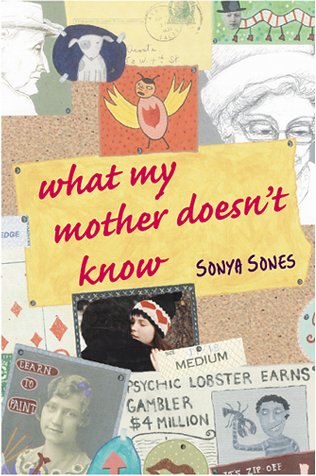
Banned Books Week: What My Mother Doesn't Know

It's that week I get most excited for, Banned Books Week!  I know, I'm such a library geek.  But I put the most planning into decorating for it, more than for any other "holiday."  I research it, and why books are banned, and what's trending in promoting the freedom to read.  And I do enjoy reading banned books.

As part of Banned Books Week, I always like to review a book that's stirred up particular controversy.  Here are my thoughts on What My Mother Doesn't Know by Sonya Sones.  It impressively made the Top Ten Banned/Challenges Books List for four nonconsecutive years.


Statistics
Checkouts: 10 checkouts from my public library (the one I run)
Typical reader: teen and tween girls
Source: My public library

Synopsis: Sophie is a boy-crazy high school freshman.  This is a free-verse account of a few of her romantic flings.

My Goodreads rating: 4 stars

Banned/challenged for (in alphabetical order): nudity, offensive language, sexism, sexual content, sexually explicit, unsuited to age group

This book has quite the curriculum vitae when it comes to controversy.  In 2004, it debuted on the Top Ten Banned/Challenged Books List at #6 for offensive language, being sexually explicit, and being unsuited to age group.  In 2005, it was at #7, for sexual content, and being unsuited to age group.  After a few years off, it came back in 2010 to regain #7, for sexism, sexually explicit, and unsuited to age group.  In 2011, it was #8, for nudity, offensive language, and being sexually explicit.  Wow.

Between the repeat infamy and the title ("Ooo, it sounds scandalous!"), I was expecting something pretty salacious.

... It isn't.

Really, it's one of the sweetest books about teenage romance that I've read.  Granted, I don't read many.  (And when I do, they tend to be angst-filled coming-out GLBT novels with plenty of heartbreak.)  Sophie is boy-crazy and knows it.  But she's a romantic, a serial-monogamist, with some sense in her hormone-addled head, giving her the ability to move on when a relationship is ending and defy peer pressure in certain instances.  No spoilers, but the hints leading to, and the actual, third romance are pretty "aw"-inspiring.

What could be wrong with this book?  (Beware of sass.)

Nudity.  There's a scene where Sophie and her girlfriends go out for a bite to eat in trenchcoats and smiles.  No one sees that they're not wearing anything underneath.  It's their little secret.  A goofy bit of fun.  (And really, unless it's illustrated, how the heck does one criticize a book for having nudity?)

Offensive language.  Sophie is Jewish, and in one instance, a rude man refers to her and her mother using a derogatory word beginning with a K.  Certainly, that's something to get a reader upset over, because they'll otherwise never hear derogatory racial/ethnic slurs.

Sexism.  I don't know.  Maybe when Sophie gets groped by a random boy after a dance, and he comments to his friends that her breasts are real?  Speaking of that scene, Sophie handled it excellently, defending herself and chasing the boys away.

Sexual content.  Sophie discusses getting her period, and tries to buy feminine products.  It's as bad as Are You There, God?  It's Me, Margaret by Judy Blume.  Oh.  Right.  That's been banned and challenged over the years, too.  We certainly can't have girls reading about other girls dealing with menstruation.  They might have been as in-the-dark as Sophie was, without instruction from her mother, and they might learn something from a book like this or the one by Judy Blume.

Sexually explicit.  Certainly, there must have been some eye-widening scenes in this book, for it to be challenged so often for this offense.  But what I found was mostly kissing.  Oh, no, the horror.  How dare teens kiss.  They're supposed to wait until after their Sweet Sixteen.

In sum, this book with the eyebrow-raising title has gotten a lot of undue criticism, in my opinion.  It's a mostly harmless book about a boy-crazy high school girl.  This novel is just a lightning rod that attracts storms from people who are overly protective of girls, and don't want them knowing about anything that can and does impact their lives during puberty.  Get over it.

Saturday, October 12, 2013

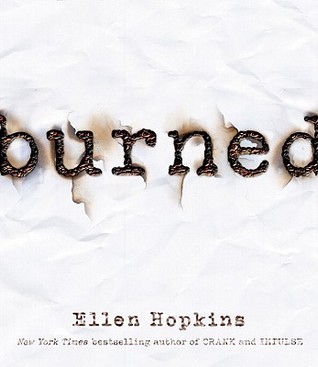
Cover-to-Cover Commuting: Burned, and Smoke, by Ellen Hopkins

I had intended to review these two books during Banned Books Week, or shortly thereafter.  It's now two weeks later.  Good heavens, I hope my readers don't actually expect me to be timely, or if you do, you forgive me.  I'm a library director, and I have a second library job.  Both jobs are a lot of work, and consume a lot of time and energy.  Much as I'd love to blog more regularly, that's not going to happen.

Librarians are like teachers.  Overworked and underpaid.

 Enough of that, though.  Let me tell you about these audiobooks!  Burned was published in 2006, while its sequel, Smoke, came out last month.

Statistics
Checkouts: Both owned in print and audio format at the small public library
Typical reader: Teens, fans of the author
Source: Burned was interlibrary loaned; Smoke was cataloged and checked out to me the day it arrived, hehe

Synopses: In Burned, Pattyn von Stratten is the eldest daughter in a fundamentalist home with an abusive father and useless mother.  Enraged by her really fairly typical teen actions, her father sends her away to his sister's ranch in rural Nevada.  There, she finds happiness and hope - which she must leave when the school year begins.  Smoke picks up not long after the cliffhanger ending of Burned, with Pattyn on the run and her sister Jackie picking up the pieces of their lives.  Can they rebuild, despite the lies and pain?

My Goodreads ratings: 5 stars for Burned, 4 stars for Smoke

Pattyn (named for General Patton; her father named all his children for generals) is likely the sweetest protagonist you could possibly find in one of Ms. Hopkins' novels.  The poor girl has a rough life, though, with a father who rules with an iron fist - which he often uses against his wife - and a fundamentalist church that looks the other way when its women need help.

When Pattyn gets into trouble with her father and at school due to a boy, she is shipped off to live with an aunt who has a ranch in rural Nevada.  This is meant as punishment, but it turns out to be the exact opposite.  There, she learns how it feels to be loved, both by her kind aunt and by a nice neighbor boy.  Love is a double-edged sword, however, which she learns when she returns home to face reality.  And man, can the consequences of love be disastrous.

The second book is narrated by both Pattyn and her sister, Jackie.  Pattyn is on the run after a horrific series of events, and tries to rebuild her life posing as an illegal immigrant worker to become a nanny on a rural Californian ranch.  (And that didn't come across as ridiculously in the book as it does when I type it.)  Meanwhile, Jackie has her own demons to face, and must help her mother and sisters cope with all that's happened.  It's a lot for a young teen girl.

Smoke is different from any other novel by Ms. Hopkins that I've read.  It's filled with so much hope.  Fans may find themselves torn between grabbing onto that hope and expecting everything to turn out okay for Pattyn and Jackie, and being cynical and waiting for it to all come crashing down, especially for Pattyn in her new life.  Can there be a happy ending?

Saturday, September 28, 2013

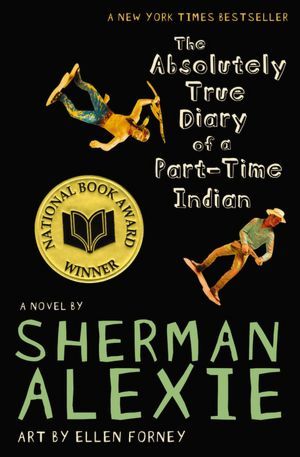
Banned Books Week: The Absolutely True Diary of a Part-Time Indian

I must say, I am shocked at how well Banned Books Week went over at my library.  Pleasantly shocked, certainly.  But still, I am in awe of just how positively the community responded to it.  People were curious, and asked questions.  And they checked out the books.  Of the Top Ten Banned Books of 2012, only The Kite Runner and Beloved were left on the shelf when I closed up this afternoon.  There seems to have been a reluctance to take the books with the pink slips on them, but hopefully those will go out next year.  Hopefully by then, the library will be in its new home (just down the street) and I'll have more room to make displays.

I also celebrated Banned Books Week by listening to book number two on the 2012 list, The Absolutely True Diary of a Part-Time Indian by Sherman Alexie.  The author himself read the book.

Statistics
Checkouts: audiobook not owned by either library
Typical reader: teens, Native Americans, fans of the author, fans of banned books
Source: my hometown library

Synopsis: Arnold "Junior" Spirit is a 14-year-old Spokane boy who lives on a reservation.  At the encouragement of a teacher, he transfers to a better school 22 miles away, where the only non-Caucasian is its Indian mascot.

My Goodreads rating: 4 stars

Banned/challenged for: offensive language, racism, sexually explicit, unsuited for age group

This is a slice-of-life story of a teen boy who changes his own life by upsetting all norms of his tribe and going to a school off the "rez."  It follows roughly a year of Junior's life, as he navigates his freshman year, friendships, racism and ostracism, loss, and basketball.

In listening to the audiobook version of this novel, I missed out on the art.  However, I gained the hilarious narration of Mr. Alexie.  I stuck the first CD in my car's player before I left the library parking lot, and proceeded to laugh all the way home.  The humor is deadpan and dry, a lot of the time.  But also, the voice the author uses for Junior's voice and internal monologue has an amazingly familiar accent.  Apparently, a brain-damaged teen Spokane boy from a reservation in Washington State sounds like a Finlander Yooper.  Seriously.  He sounds like my dad's Uncle Reino.  If you don't know what a thick Yooper accent sounds like, watch the movie Fargo and listen, particularly to the women in the bar ... or listen to this audiobook.

I loved this book.  It covers a wide range of emotions and life experiences.  Pretty much any teen could read it and recognize something for his or her life.  It's humorous, and it also has plenty of hyperbole.  Many of the stories remind me of American tall tales.

Does this book deserve its negative acclaim?  Let's break it down.
  1. Offensive language.  Everyone has a different definition of this.  But yes, there is a sentence where a character not only drops the F-bomb, but also uses the N-word.  It's a pretty knockout use, too, that really covers ...
  2. Racism.  Yup.  The sentence with the aforementioned words was definitely racist.  And there's also racism between Native Americans and Caucasians.  There's also a sort of racism within an ethnic people, as demonstrated by how other reservation inhabitants called Junior an "apple:" red on the outside, white on the inside.  But it's intrinsic to the story.  If everybody got along, if the US government had not discriminated against Native Americans and pushed many onto reservations, if ethnic groups did not stick together and create out-groups and outcasts, then maybe we wouldn't need stories that deal with racism.  People that complain about racism in this book need a reality check.
  3. Sexually explicit.  This isn't 50 Shades.  The most Junior does with a girl is kiss.  There are "gay" jokes.  The most sexually explicit thing would have to be his admissions that he masturbates.
  4. Unsuited for age group.  Because teens don't read about teens?  Sure, it's not what you might want to hand to a child in elementary school, but that's not its intended audience.  Teens are.  And teens can and should read it, and they can and should handle the book just fine.
In sum, beyond one over-the-top sentence that was important to a plot element (white guy insults Junior, Junior punches him, they become friends), this book is tame and appropriate for its intended audience.

What did you read for Banned Books Week?

Thursday, September 26, 2013

Banned Books Week!

It's my favorite library time of year again: Banned Books Week!  This year, it's going amazingly well for me.  On Monday, before the small public library opened, I created a book display.  It had the Top Ten Banned Books of 2012, each with the rationale for banning and challenging.  Impressively, the library has nine out of ten; only And Tango Makes Three is not owned.  I also put together various books for the rest of the display shelving, and some face-out books above the shelves and on some tables.  The face-out books had slips of paper on them, with information about their challenges.

On Tuesday, my staff told me what a hit the display was.  I was shocked, because I honestly didn't know how it would go over in a small, rural town with an aged service population.  But a high school teacher checked out two young adult books to discuss censorship, and the books themselves, with his classes.  Patrons - and staff members - were intrigued by the reasons on the books, and wanted more!  So I labeled the rest of the books on display.

Here are some pictures of Banned Books Week in my little library.  I'm so pleased at the reception it's received.

Top Ten Banned Books of 2012
Several are checked out!
The key to a successful Banned Books Week is to celebrate the freedom to read.
The note on The Witches declares that Roald Dahl is a misogynist.

Classics are often banned and challenged.
The Call of the Wild
The Call of the Wild was burned in 1929 in Italy and Yugoslavia for being "too radical."

There are some wild women in books.
Harriet will teach your children to spy, lie, and swear, while Scarlett behaved immorally.

Children's and young adults' books are frequently called into question.
Remember, read freely and responsibly, and you and you alone are responsible for what you read.  Not other people.  And you have no right to tell other people what they can and cannot read, either.  Only minors in your care are subject to your views.


I have been reading some books greatly appropriate for this week, and will have to review them by the end of Saturday!  Stay tuned for a double feature of Burned and its recently published sequel, Smoke, by Ellen Hopkins, and a review of the audio version of The Absolutely True Diary of a Part-Time Indian (one of 2012's top ten), written and read by Sherman Alexie.

Sunday, September 30, 2012

Banned Books Week: Crank, by Ellen Hopkins

Unlike last year, I'm taking Banned Books Week seriously here and reviewing a book that has been banned and challenged.  I recently listened to the audiobook version of Crank by Ellen Hopkins, and realized that it was perfect for this feature.  It has been challenged for drugs, offensive language, and being sexually explicit.  This has happened all over the country, often with the worst result possible: it's been banned.  It was #4 on the American Library Association's most frequently challenged book list for 2010.  The author, who has had many of her books challenged or banned, has even been repeatedly dis-invited from speaking events.

That's particularly sad because Crank is semi-biographical, about Ms. Hopkins' own daughter's descent into drug use.

So let's take a look at this book.


Statistics
Checkouts: not owned by the charter school; 6 checkouts of the paperback at the school/public; no statistics available for audiobook (interlibrary loan)
Typical reader: curious teens, and drug users
Source: Interlibrary loan

Synopsis: Kristina Snow was the perfect daughter and student.  Then she went to visit her father one summer, where she tried crank - the monster, methamphetamine.  At first, it was great.  But then it led her into a special sort of hell.

My Goodreads rating: 4 stars

I went with the audiobook for this one because it's written in free verse.  Between my dislike for that form of poetry, and the fact that I just can't read poetry (blaming high school English for that), it seemed like a good choice.  And it is, just for time's sake - the audiobook is 4 discs long, whereas the paperback is a whopping 537 pages.  But it's also good for the quality of narration.  Laura Flanagan delivers the story well, with feeling and a teen-sounding voice.  She handles the verse format better than I ever could, making it more lyrical and less cumbersome.

Crank is a rough book, any which way you read it.  It deals with some very hard subjects.  Kristina gets into a lot of trouble due to her drug use.  This includes trouble at home with her family, with her finances, at school, with her friends, and with boys.  Some of that is very serious.

This book has been banned and challenged for drugs, offensive language, and being sexually explicit.  Well, yes, it does have all of that.  Sometimes people challenge books for the oddest perceived faults; this time, they're right.  The book is about drug use.  Is it glamorized?  Hardly.  There's offensive language, but that seems superfluous.  As for being sexually explicit, let me give you some spoilers.  Kristina gets raped, and that is described a bit.  It's worth cringing over.  She talks with a fellow female drug user about it, and finds out that it's happened to the friend as well.  Girls that use drugs often get raped by dealers, or by guys that offer to help them get high.  And as a final lesson in what bad things can happen when a girl uses drugs, she discovers that she's pregnant, and it's the rapist's baby.

Is this appropriate for young children?  No, but I doubt anyone found it in an elementary collection.  Is it appropriate for teens?  That's a good question.  It's written for teens, about a teen, based on a real teen girl.  But parents should certainly be aware that their teen is reading it.  This is a novel that needs discussion.  Don't take it away, just because of a fear that it might make them curious or lead them astray.  The consequences of Kristina's drug-addled actions become clear enough by the end of the book.  Discuss it with them.  Talk about how drugs can mess up their lives.

I really have to give kudos to Ms. Hopkins for writing this book and its direct sequel, Glass.  She was struggling with how and why her daughter could go down the path of meth use, and this book explores what happened, or may have happened.  She's been praised by people who have used meth, for accurately portraying what it's like.  Some have even told her how the books have helped them clean up.

If that's not a reason to keep the book on the shelf, what is?


Have a good Banned Book Week, everyone.  Enjoy your freedom to read.  Do you have a favorite challenged book, or one that you're reading in honor of this week?


On to a lighter subject.  Tomorrow is the first day of October.  October shall be a special month here, where a librarian moonlights as a librarian.   I'm going to take the month to focus on books of Marvelous Michigan!  I'll be exploring new and old books for all ages, that are by Michigan authors, or are set in Michigan, or are about this state of pleasant peninsulas.  I might even have an author interview or two.  Stay tuned - I hope you'll love it.

Thursday, September 29, 2011

Banned Books Week: Eve, by Anna Carey

Happy Banned Books Week!  The last week of September is the American Library Association's recognition of attempts to inhibit reading and celebration of the First Amendment freedoms of speech and of the press - which backs Americans' right to read.  I spent yesterday, as well as a bit of today, talking to classes at all levels about Banned Books Week and what it means.  This "holiday" is one of my favorites, perhaps second only to Halloween.

For my review this week, I'm taking a bit of a different approach to the celebration.  Rather than reviewing a classic banned/challenged book - and most books considered "classics" have been challenged at some point - or a more recent book that has made the list, I'm reviewing an advanced copy of a book published by HarperCollins.

What's the significance of this?  Earlier this year, HarperCollins decided to change their eBooks from permanent entities to files that disappear after 26 uses.  If a library owns one of their eBooks and it gets checked out every other week, it will no longer be part of the collection after a year.  This is utterly ridiculous in comparison to the shelf-life of the average physical library book.  So, with backing from the digital media service Overdrive - which provides thousands of digital audiobooks and eBooks to libraries around the world - libraries started a boycott against HarperCollins.  "We're not buying your books until this changes," we say.  Sometimes this means only eBooks, sometimes it encompasses all forms of books published by HarperCollins and all of its imprints.  But until HarperCollins changes its policy, many libraries are not buying.

Unfortunately, the company publishes a lot of great teen books.

This week, since I'm banned from buying HarperCollins books, I'm going to be naughty and tell you about a book they have coming out next week.  It's Eve by Anna Carey.  I got an advanced reader's edition for free from Snowbound Books to review.

Statistics
Checkouts: It goes on sale October 4, and it's published by HarperCollins. Unless it's donated, I don't expect this to show up on the shelves.
Typical reader: Teen girls

Synopsis: In a post-apocalyptic future where 98% of the world's population has fallen victim to a plague, an orphan named Eve has done well in her all-girls School and will be graduating valedictorian of her class.  But a fellow senior, Arden, has seen what really awaits them in "trade school" after graduation, and escapes.  Eve finds out that Arden was right, and with the help of a teacher, slips away the night before the graduation ceremony.  Eventually she meets a young man, Caleb, who rescues her from danger and shows her that men are not the horrible monsters she has been taught to fear.  But the King's men are looking for her.  Can she and Arden make it to the safety of Califia?

My Goodreads rating: 5 stars (4.5, really)

If the final version of the cover of this gives the book comparisons the galley's cover offers, it's not going to be a surprise to learn (provided you're familiar with The Handmaid's Tale by Margaret Atwood) that what awaits the girls in "trade school" is naught but helping to repopulate the world as demanded by the King of the New America.  Eve sneaks over to see the building where she thought she would pursue her dreams of becoming a muralist and sees girls she'd known from older grades strapped to bed with massive, pregnant bellies and sorrowful faces.  Orphan girls sent to the schools end up as "sows," artificially inseminated and destined to suffer multiple births for the next 20 years of their lives in captivity.  No wonder Arden and Eve run away.

The wilds outside the City and the sequestered Schools are fraught with dangers - roving gangs, animals, and horror of all horrors, men.  The Schools teach the girls to fear all men, save for the King, and put spins on classic stories ranging from Romeo and Juliet to Lord of the Flies to show the dangerous, depraved ways of the male of the species.  So it's a bit amazing that Eve actually accepts being saved by a young man on horseback from a mother bear.

Thus begins one of the healthiest, most natural romances I've read in young adult literature in a good while.  Seriously.  If you're tired of bad boys, abusive vampires, fallen angels, and all of it, that's reason enough to pick up the book.  Caleb is one of the nicest, sweetest, most devoted love interests available in teen novels today.  He's completely realistic too, with flaws and insecurities that befit his age.

I also really liked the supporting female character, Arden.  In the course of the story, Eve learns that there's much more to her raven-haired former classmate than just all the gags and pranks she used to play.  Arden is tough, smart, determined.  She's a fascinating character that moves in and out of Eve's story as the plot plays out all of its twists and turns.  I don't want to give anything away, but I sincerely hope she shows up in the second book of the trilogy.

The story is pretty solid and interesting.  There are good times and horrific ones as Eve and Arden try to go west to Califia, where their teacher said refuge could be found.  Can they make it?  Will Caleb stay with them, or only help them get there?  Will they be intercepted by the King's men, who are specifically looking to bring Eve back alive to their leader?  When will the second book be released, so I can find out what happens next?

Will HarperCollins relent their position on limiting eBooks, so I can actually buy this series??  (You can follow and learn more about the boycott at http://boycottharpercollins.com/)