Pages

Showing posts with label award-winners. Show all posts

Saturday, September 28, 2013

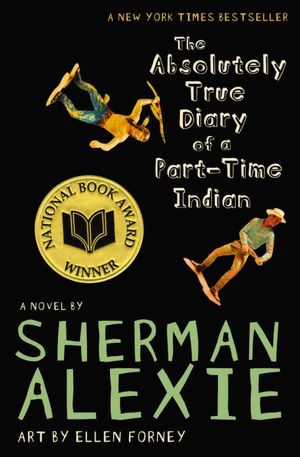
Banned Books Week: The Absolutely True Diary of a Part-Time Indian

I must say, I am shocked at how well Banned Books Week went over at my library.  Pleasantly shocked, certainly.  But still, I am in awe of just how positively the community responded to it.  People were curious, and asked questions.  And they checked out the books.  Of the Top Ten Banned Books of 2012, only The Kite Runner and Beloved were left on the shelf when I closed up this afternoon.  There seems to have been a reluctance to take the books with the pink slips on them, but hopefully those will go out next year.  Hopefully by then, the library will be in its new home (just down the street) and I'll have more room to make displays.

I also celebrated Banned Books Week by listening to book number two on the 2012 list, The Absolutely True Diary of a Part-Time Indian by Sherman Alexie.  The author himself read the book.
Statistics
Checkouts: audiobook not owned by either library
Typical reader: teens, Native Americans, fans of the author, fans of banned books
Source: my hometown library

Synopsis: Arnold "Junior" Spirit is a 14-year-old Spokane boy who lives on a reservation.  At the encouragement of a teacher, he transfers to a better school 22 miles away, where the only non-Caucasian is its Indian mascot.

My Goodreads rating: 4 stars

Banned/challenged for: offensive language, racism, sexually explicit, unsuited for age group

This is a slice-of-life story of a teen boy who changes his own life by upsetting all norms of his tribe and going to a school off the "rez."  It follows roughly a year of Junior's life, as he navigates his freshman year, friendships, racism and ostracism, loss, and basketball.

In listening to the audiobook version of this novel, I missed out on the art.  However, I gained the hilarious narration of Mr. Alexie.  I stuck the first CD in my car's player before I left the library parking lot, and proceeded to laugh all the way home.  The humor is deadpan and dry, a lot of the time.  But also, the voice the author uses for Junior's voice and internal monologue has an amazingly familiar accent.  Apparently, a brain-damaged teen Spokane boy from a reservation in Washington State sounds like a Finlander Yooper.  Seriously.  He sounds like my dad's Uncle Reino.  If you don't know what a thick Yooper accent sounds like, watch the movie Fargo and listen, particularly to the women in the bar ... or listen to this audiobook.

I loved this book.  It covers a wide range of emotions and life experiences.  Pretty much any teen could read it and recognize something for his or her life.  It's humorous, and it also has plenty of hyperbole.  Many of the stories remind me of American tall tales.

Does this book deserve its negative acclaim?  Let's break it down.
  1. Offensive language.  Everyone has a different definition of this.  But yes, there is a sentence where a character not only drops the F-bomb, but also uses the N-word.  It's a pretty knockout use, too, that really covers ...
  2. Racism.  Yup.  The sentence with the aforementioned words was definitely racist.  And there's also racism between Native Americans and Caucasians.  There's also a sort of racism within an ethnic people, as demonstrated by how other reservation inhabitants called Junior an "apple:" red on the outside, white on the inside.  But it's intrinsic to the story.  If everybody got along, if the US government had not discriminated against Native Americans and pushed many onto reservations, if ethnic groups did not stick together and create out-groups and outcasts, then maybe we wouldn't need stories that deal with racism.  People that complain about racism in this book need a reality check.
  3. Sexually explicit.  This isn't 50 Shades.  The most Junior does with a girl is kiss.  There are "gay" jokes.  The most sexually explicit thing would have to be his admissions that he masturbates.
  4. Unsuited for age group.  Because teens don't read about teens?  Sure, it's not what you might want to hand to a child in elementary school, but that's not its intended audience.  Teens are.  And teens can and should read it, and they can and should handle the book just fine.
In sum, beyond one over-the-top sentence that was important to a plot element (white guy insults Junior, Junior punches him, they become friends), this book is tame and appropriate for its intended audience.

What did you read for Banned Books Week?

Thursday, September 5, 2013

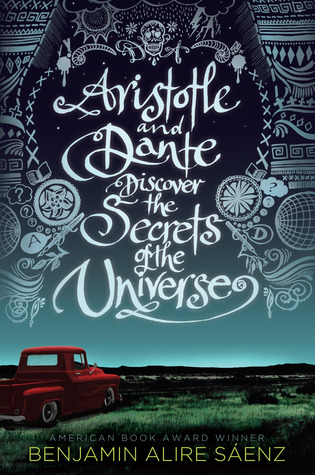
Yay for YA: Aristotle and Dante Discover the Secrets of the Universe

I've gushed over books that have received the Michael L. Printz Award, or have been honor winners of the award, before, so I'll spare you the swooning with this review.  On the other hand, this book (a Printz honor recipient) won a Stonewall Book Award, as well as the Pura Belpre Award, and probably others but the copy I had access to only had so much cover space for award stickers.  And it has a great title.

Today I shall tell you about Aristotle and Dante Discover the Secrets of the Universe.  Doesn't it just sound grand?

Statistics
Checkouts: 1 at the small public library
Typical reader: Teens drawn to literature that isn't heteronormative (I'm not trying for the acronym that keeps growing ...), fans of the author and/or award-winning books
Source: My small public library

Synopsis: In this slice-of-life tale set in the late 1980s, two Mexican-American teen boys become friends and try to find their places in life.

My Goodreads rating: 4 stars

For having such a grandiose name harkening back to a well-known Ancient Greek philosopher, Aristotle (Ari) does not have many far-reaching ambitions.  He feels like his life is someone else's idea.  And in the summer of 1987, he was not aspiring to much beyond lazing about for the summer, perhaps at the pool despite not knowing how to swim.  But at the pool, he meets Dante, another Mexican-American teen boy with a lofty name, who offers to teach him how to swim and thus ignites a friendship.

This is a pretty pedestrian story, very slice-of-life, without goals.  Nothing exciting or thrilling happens for the first hundred pages.  (Then something potentially life-changing does.  But you know me, I don't do spoilers.)  Yet it has so much heart.  Plot is secondary to character and relationship growth and development.  Self-discovery and the complexities of friendships are the key elements of this book, and they really shine.

One part I had problem with was the resolution of the story.  I didn't particularly believe it.  Since I don't give away spoilers, it's hard to explain, but it didn't ring true for me.  While I've been known to be a poor judge of a certain characteristic pivotal to the end of the book, I also don't believe I was led as a reader to reach the conclusion that Ari did.  Your mileage may vary.

Monday, September 10, 2012

Cover-to-Cover Commuting: Looking for Alaska

I am a fan of the Printz Awards.  If you're into young adult literature, or are involved in librarian-like pursuits, you're probably familiar with them.  Akin to the Caldecott and Newbery Awards for younger audiences, the Michael L. Printz Award is the American Library Association's award for a book that "exemplifies literary excellence in young adult literature."  For more information, visit the ALA's page about it.

I've previously read other Printz winners, such as the gritty Ship Breaker by Paolo Bacigalupi (review available here), the quirky graphic novel American Born Chinese by Gene Luen Yang, the heartbreaking The First Part Last by Angela Johnson (that was for a class), and the bleak Monster by Walter Dean Myers.  All of those have been very good.  The book I want to share with you now is also an outstanding Printz winner, called Looking for Alaska by John Green.  I listened to the audiobook version.


Statistics
Checkouts (School/public audiobook): 30
Checkouts (Charter school print):5
Typical reader: Mature teens
Source: School/public library, on audio CD

Synopsis: Miles decides to leave home and attend his junior year of high school at his father's alma mater, a boarding school in Alabama, hoping to find more to life and discover his "Great Perhaps" (a reference to the last words of Francois Rabelais).  There, he makes friends with interesting classmates, most notably the beautiful, clever, sultry Alaska Young.  This comes across as a great "slice of life" tale, until one night ...

My Goodreads rating: 4 stars

Does Looking for Alaska exemplify literary excellence in YA lit?  Oh, yes.  It's genuine, edgy, unafraid to look at teen issues.  While the Printz Awards can go to any genre of book, provided that the intended audience is teen/YA, this is lovably contemporary, realistic fiction.  As much as I like fantasy and dystopian novels, this had great appeal for the realism: in the characters, in the events, in the setting.

This is character-driven, and the people in Miles' life are quirky and interesting.  Miles himself, or "Pudge," as he is known at school since he's skinny,  has the unique trait of being obsessed with last words of famous people.  Alaska is extremely multifaceted, from being sweet and funny, to railing against the "patriarchal paradigm," to withdrawing into deep melancholia.  Even the allegedly one-lunged religious studies professor has his idiosyncrasies.

This is a hard book to discuss without getting into spoilers, though.  There's definitely a turning point in the novel, and the chapters/sections are even marked with "eleven days before" or "one day after."  Certainly, something momentous happens, but if you've been reading my reviews for a while, you know I try to steer clear of letting things slip if I can help it.  My advice: if you want to read this, just jump into it, and don't look at the reviews on Goodreads.  I made that mistake, and was not happy.

The audiobook version of this was good.  Not outstanding, but good.  There's a part where Miles, narrating the story, comments on someone's Southern drawl, and that most people at school didn't have such an accent.  *sigh*  Maybe it's just my acclimation to how people in the upper Midwest talk, but I swear a lot of the characters had a bit of a Southern accent.  Nice to listen to, but inaccurate.

This novel is certainly for more mature readers.  Miles and his friends live boarding school life to its fullest.  They pull pranks, smoke, drink, explore their sexuality, and examine the meaning of life, be it in pursuit of the "Great Perhaps" or a way "out of the Labyrinth."  There are also mature themes.

Monday, December 5, 2011

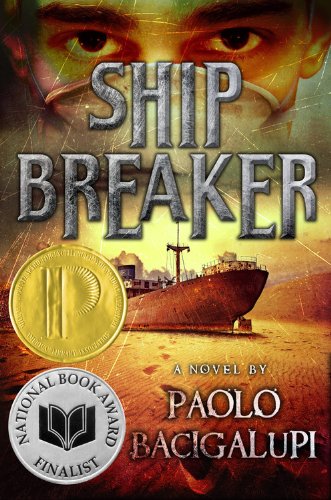
Yay for YA: Ship Breaker, by Paolo Bacigalupi

Isn't it nice when you read a book that has won awards, and you find it really did deserve those awards?  Ship Breaker by Paolo Bacigalupi won the 2011 Michael L. Printz Award, which is one of the American Library Association's highest awards for young adult literature, as well as several other distinctions.  And it's well-earned.
Statistics
Checkouts: Not owned by the school library yet
Typical reader: Teen boys
Book source: Personallly bought at the Scholastic Book Fair

Synopsis: Nailer, a teenage boy, lives along America's Gulf Coast, earning a living in a light crew, scavenging old tankers and other boats for copper wiring and other valuables.  He nearly dies after falling from a collapsing duct into a hidden oil pocket in a ship, but his run of luck begins and he manages to free himself.  The next day, a monstrous hurricane blows through the area.  Afterward, he and a crew mate find a beached clipper ship off a nearby island.  There's a lone survivor, and despite losing the privilege of scavenging the boat, he decides to rescue her.  But at what cost?

My Goodreads rating: 5 stars

If I had to sum up this book in one word, it would be: Intense!  This is a book that just won't quit amazing the reader.  The action is nonstop, the dystopian future is believable and expertly designed, and the characters are awesome.  I want to gush about this novel, but am restraining myself for the sake of a coherent review.

Life is tough in the future.  Climate change has apparently occurred, with the polar ice caps gone, shorelines changed around the world, and "city breaker" F6 hurricanes bombarding the Gulf Coast so much that after Orleans 3, the people gave up on trying to have decent cities in the lowlands of Louisiana.  But there are plenty of old abandoned tankers and other metal ships in the vicinity, ready for crews to scavenge everything useful from them.  Oil is a scarce, precious resource, a relic occasionally found on the old gas-guzzling ships of the past.  The book is never preachy, though.  The characters are struggling to survive too much for that.

The characters are perfectly flawed.  Everyone has a hard life in Nailer's world, from the low-life trash that break their oaths to their crew, to the "swank," the members of the upper class with their internal politics and backstabbing.  There are no flat characters here, no black-and-white heroes and villains, no throw-away character filling a stereotype.  Another thing I liked about the characters was that they could grow and learn.  This was particularly true of the protagonist, Nailer, and the swank he saves from the clipper, Nita.  Nita never came across a plot device, despite being a driving force behind much of the story, and her experiences outside her "white-bread world" really added to her character.

There is a companion book, The Drowned Cities, due out next spring.  It features a secondary character that was quite interesting in my opinion: Tool, a genetically engineered half-man, similar to a werewolf minus the shapeshifting, who has no master.  I'll be looking forward to it.