I think that getting back into reviewing books with one of the best contemporary preteen books I've read in a while is a good way to do this.
Statistics
Checkouts: Not owned by either library ... yet
Typical reader: Preteens or teens interested in contemporary coming-of-age books, have ties to either ethnicity/religion portrayed in this book, or are attracted by the quirky, catchy title
Source: Advanced reading copy courtesy of Snowbound Books (It came out last October. I'm behind in my reading.)
Synopsis: Tara Feinstein, an Indian-Jewish-American preteen girl living in New York City, is preparing for her bat mitzvah. Being multicultural, she's not sure in how she fits in to either her mom's Indian culture or her dad's Jewish one, or what exactly she even believes. Adding to her worries are the fact that her best friend Rebecca is spending more time with a snobbish girl from both their middle school and Hebrew school, and her other best friend Ben-O may or may not like her as more than a friend. Oy vey!
My Goodreads rating: 5 stars
I really enjoyed reading this book. Ever have a book that you're reading, that's so good that you slow down and try to drag out the last few chapters so it will last longer? This book was like that for me.
It's well-written. The dialogue and internal monologue are realistic and believable. There was a decent balance of description - not so little that it would turn me off, and not too much for a preteen reader. Characters are well-rounded. The plot and subplots are interesting, yet resolvable by the end of the book.
And best of all, it has a glossary.
Don't worry, I am kidding when I say that a glossary is the best thing about a book. But it helps! Hardly anyone is going to be familiar with all the Yiddish, Hebrew, and Hindi words, much less the blended ones. The glossary is also seasoned with the humor of the protagonist, making it part of the enjoyable read.
I'd be hard-pressed to nitpick and find little flaws with this book. Sure, it's not perfect - nothing is - but this is really darned good.
I'm a librarian moonlighting as a librarian. I'm currently working at two Michigan libraries: a small town public library, where I am now the director, and a K-12 public charter school. I write reviews of YA and juvenile fiction, and books set in Michigan and/or written by Michigan authors. I also occasionally discuss libraries and library science.
Showing posts with label multicultural. Show all posts
Wednesday, July 2, 2014
Yay for YA: My Basmati Bat Mitzvah, by Paula J. Freedman
Labels:
contemporary,
India,
multicultural,
realistic_fiction,
reviews,
ya
Saturday, September 28, 2013
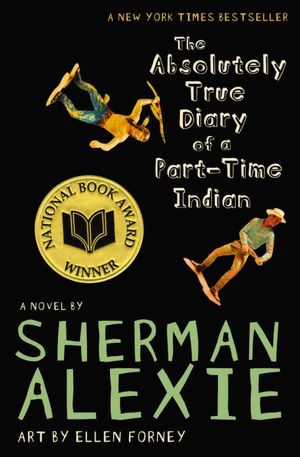
Banned Books Week: The Absolutely True Diary of a Part-Time Indian
I must say, I am shocked at how well Banned Books Week went over at my library. Pleasantly shocked, certainly. But still, I am in awe of just how positively the community responded to it. People were curious, and asked questions. And they checked out the books. Of the Top Ten Banned Books of 2012, only The Kite Runner and Beloved were left on the shelf when I closed up this afternoon. There seems to have been a reluctance to take the books with the pink slips on them, but hopefully those will go out next year. Hopefully by then, the library will be in its new home (just down the street) and I'll have more room to make displays.
I also celebrated Banned Books Week by listening to book number two on the 2012 list, The Absolutely True Diary of a Part-Time Indian by Sherman Alexie. The author himself read the book.
Statistics
Checkouts: audiobook not owned by either library
Typical reader: teens, Native Americans, fans of the author, fans of banned books
Source: my hometown library
Synopsis: Arnold "Junior" Spirit is a 14-year-old Spokane boy who lives on a reservation. At the encouragement of a teacher, he transfers to a better school 22 miles away, where the only non-Caucasian is its Indian mascot.
My Goodreads rating: 4 stars
Banned/challenged for: offensive language, racism, sexually explicit, unsuited for age group
This is a slice-of-life story of a teen boy who changes his own life by upsetting all norms of his tribe and going to a school off the "rez." It follows roughly a year of Junior's life, as he navigates his freshman year, friendships, racism and ostracism, loss, and basketball.
In listening to the audiobook version of this novel, I missed out on the art. However, I gained the hilarious narration of Mr. Alexie. I stuck the first CD in my car's player before I left the library parking lot, and proceeded to laugh all the way home. The humor is deadpan and dry, a lot of the time. But also, the voice the author uses for Junior's voice and internal monologue has an amazingly familiar accent. Apparently, a brain-damaged teen Spokane boy from a reservation in Washington State sounds like a Finlander Yooper. Seriously. He sounds like my dad's Uncle Reino. If you don't know what a thick Yooper accent sounds like, watch the movie Fargo and listen, particularly to the women in the bar ... or listen to this audiobook.
I loved this book. It covers a wide range of emotions and life experiences. Pretty much any teen could read it and recognize something for his or her life. It's humorous, and it also has plenty of hyperbole. Many of the stories remind me of American tall tales.
Does this book deserve its negative acclaim? Let's break it down.
What did you read for Banned Books Week?
I also celebrated Banned Books Week by listening to book number two on the 2012 list, The Absolutely True Diary of a Part-Time Indian by Sherman Alexie. The author himself read the book.
Statistics
Checkouts: audiobook not owned by either library
Typical reader: teens, Native Americans, fans of the author, fans of banned books
Source: my hometown library
Synopsis: Arnold "Junior" Spirit is a 14-year-old Spokane boy who lives on a reservation. At the encouragement of a teacher, he transfers to a better school 22 miles away, where the only non-Caucasian is its Indian mascot.
My Goodreads rating: 4 stars
Banned/challenged for: offensive language, racism, sexually explicit, unsuited for age group
This is a slice-of-life story of a teen boy who changes his own life by upsetting all norms of his tribe and going to a school off the "rez." It follows roughly a year of Junior's life, as he navigates his freshman year, friendships, racism and ostracism, loss, and basketball.
In listening to the audiobook version of this novel, I missed out on the art. However, I gained the hilarious narration of Mr. Alexie. I stuck the first CD in my car's player before I left the library parking lot, and proceeded to laugh all the way home. The humor is deadpan and dry, a lot of the time. But also, the voice the author uses for Junior's voice and internal monologue has an amazingly familiar accent. Apparently, a brain-damaged teen Spokane boy from a reservation in Washington State sounds like a Finlander Yooper. Seriously. He sounds like my dad's Uncle Reino. If you don't know what a thick Yooper accent sounds like, watch the movie Fargo and listen, particularly to the women in the bar ... or listen to this audiobook.
I loved this book. It covers a wide range of emotions and life experiences. Pretty much any teen could read it and recognize something for his or her life. It's humorous, and it also has plenty of hyperbole. Many of the stories remind me of American tall tales.
Does this book deserve its negative acclaim? Let's break it down.
- Offensive language. Everyone has a different definition of this. But yes, there is a sentence where a character not only drops the F-bomb, but also uses the N-word. It's a pretty knockout use, too, that really covers ...
- Racism. Yup. The sentence with the aforementioned words was definitely racist. And there's also racism between Native Americans and Caucasians. There's also a sort of racism within an ethnic people, as demonstrated by how other reservation inhabitants called Junior an "apple:" red on the outside, white on the inside. But it's intrinsic to the story. If everybody got along, if the US government had not discriminated against Native Americans and pushed many onto reservations, if ethnic groups did not stick together and create out-groups and outcasts, then maybe we wouldn't need stories that deal with racism. People that complain about racism in this book need a reality check.
- Sexually explicit. This isn't 50 Shades. The most Junior does with a girl is kiss. There are "gay" jokes. The most sexually explicit thing would have to be his admissions that he masturbates.
- Unsuited for age group. Because teens don't read about teens? Sure, it's not what you might want to hand to a child in elementary school, but that's not its intended audience. Teens are. And teens can and should read it, and they can and should handle the book just fine.
What did you read for Banned Books Week?
Labels:
award-winners,
banned_books,
banned_books_week,
ccc_audiobooks,
contemporary,
multicultural,
reviews,
ya
Sunday, January 6, 2013
Yay for YA: Choke, by Diana Lopez
I seem to have been on a bit of a teen problem novel kick lately. Here's my review of a fairly new book called Choke by Diana Lopez.
Statistics
Checkouts: New to the charter school library
Typical reader: Middle school and teen girls
Source: Scholastic book fair, recommended for the collection by a high school student
Synopsis: Windy is a fairly typical eighth grade girl, in the "general population" of her school hierarchy, wishing she could change her appearance, improve her grades and her status, that sort of thing. She seems to hit a lucky break when a new girl, Nina, comes to school and befriends her. Nina even wants to be "breath sisters," but as Windy finds out what this means, she's not so sure she wants to be a breath sister.
My Goodreads rating: 4 stars
Let me start by saying that while this is written below the reading level of the intended audience, I understand why. The author is a teacher who encountered the problem dealt with in this book, and to get out the warning to everyone likely to be intrigued by "the choking game," she had to write it more simply than the grade level. It's like how newspaper articles are written approximately to the third grade reading level, so the largest literate audience can benefit from them. The struggling, reluctant reader can read an interesting, current novel that doesn't get too preachy, just as the top student in the class can.
So, don't expect the prose to be breathtaking. (Sorry, the pun just slipped out.) The plot is a bit predictable, too. The characters and the realism hold the book together, though. Windy is as quirky as any protagonist you'd find in a John Green novel, and is realistic and well-rounded. She has high and low points, interests that any middle school girl would have, and problems any could encounter as well. Middle school is a tumultuous time of establishing pecking order, and a plot of the story lines deal with that. And what teen or almost-teen doesn't want to fit in and be attractive? But self-image issues are not the exclusive territory of the young, and Windy's perception of herself is mirrored by her father's struggle to be less Latino to get a job as a TV weatherman.
I didn't find the book to be preachy in its message, which is an important message indeed. Asphyxiation is not something anyone should be experimenting with. It's hard to imagine why anyone would try it, but in middle school, there's plenty of peer pressure, and tweens and teens are risk-takers. People can end up with brain damage from it, or even die. Remember actor David Carradine's death a few years back? This isn't just something youngsters try.
On a happier subject, I've passed the 100 mark with GFC (Google Friends Connect) followers this weekend! How exciting! I'll be celebrating later this week with a giveaway. Stay tuned for details.
Statistics
Checkouts: New to the charter school library
Typical reader: Middle school and teen girls
Source: Scholastic book fair, recommended for the collection by a high school student
Synopsis: Windy is a fairly typical eighth grade girl, in the "general population" of her school hierarchy, wishing she could change her appearance, improve her grades and her status, that sort of thing. She seems to hit a lucky break when a new girl, Nina, comes to school and befriends her. Nina even wants to be "breath sisters," but as Windy finds out what this means, she's not so sure she wants to be a breath sister.
My Goodreads rating: 4 stars
Let me start by saying that while this is written below the reading level of the intended audience, I understand why. The author is a teacher who encountered the problem dealt with in this book, and to get out the warning to everyone likely to be intrigued by "the choking game," she had to write it more simply than the grade level. It's like how newspaper articles are written approximately to the third grade reading level, so the largest literate audience can benefit from them. The struggling, reluctant reader can read an interesting, current novel that doesn't get too preachy, just as the top student in the class can.
So, don't expect the prose to be breathtaking. (Sorry, the pun just slipped out.) The plot is a bit predictable, too. The characters and the realism hold the book together, though. Windy is as quirky as any protagonist you'd find in a John Green novel, and is realistic and well-rounded. She has high and low points, interests that any middle school girl would have, and problems any could encounter as well. Middle school is a tumultuous time of establishing pecking order, and a plot of the story lines deal with that. And what teen or almost-teen doesn't want to fit in and be attractive? But self-image issues are not the exclusive territory of the young, and Windy's perception of herself is mirrored by her father's struggle to be less Latino to get a job as a TV weatherman.
I didn't find the book to be preachy in its message, which is an important message indeed. Asphyxiation is not something anyone should be experimenting with. It's hard to imagine why anyone would try it, but in middle school, there's plenty of peer pressure, and tweens and teens are risk-takers. People can end up with brain damage from it, or even die. Remember actor David Carradine's death a few years back? This isn't just something youngsters try.
On a happier subject, I've passed the 100 mark with GFC (Google Friends Connect) followers this weekend! How exciting! I'll be celebrating later this week with a giveaway. Stay tuned for details.
Labels:
contemporary,
multicultural,
realistic_fiction,
reviews,
ya
Wednesday, October 24, 2012
Marvelous Michigan Month: Living on Sisu
One nice thing about historical fiction is that it can be objectively assessed. Is it historically accurate? If it changes events, is it still realistic? Does the author do a good job of weaving fact and fiction together to create a story that is both enjoyable and informative?
With these criteria in mind, I am very happy to tell you about Living on Sisu: The 1913 Union Copper Strike Tragedy by Deborah K. Frontiera.
Statistics
Michigan connection: The story takes place in Red Jacket (Calumet), Michigan. Ms. Frontiera is a Michigan author.
Checkouts: Coming soon to the charter school library
Typical reader: Fans of the Dear America series; students looking for an historical fiction.
Source: The author
Synopsis: Twelve-year-old Emma Niemi has a good life with her immigrant parents in the mining town of Calumet, Michigan. But then a workers' strike changes everything for her and those in the area, culminating in unimaginable tragedy.
My Goodreads rating: 5 stars
This book is basically the perfect example of an historical fiction for juvenile readers. It is realistic, captivating, historically accurate, and sprinkled with pertinent ethnic vocabulary. There is a map of the area, with points of interest marked. There are a glossary, a list of historical people mentioned or featured in the book, historical notes, and a bibliography. I don't think I could ask for more.
But you could ask for more of a review than that.
This novel is presented in a diary format. Emma is given a journal for her birthday, and she records the events of the following year. And what a year it is. The Calumet area, which was home to nearly 90,000 people at the time, is torn asunder by a workers' strike. Underground copper mining was, and is, a very dangerous operation, and it has taken many lives over the years. The workers demanded less hours per day, better working conditions, and more pay. The companies owned much of the town, and felt that giving workers housing, a library, schools, hospitals, and other amenities was already generous. I'm oversimplifying, but the main thing is, trouble brewed to the boiling point.
Emma is a strong, persevering narrator. To help the family, she starts offering help at a store in exchange for a little food or money. Later, she finds employment as a housekeeper, and gives all her money to her mother. She attends night classes in order to continue her seventh grade studies. Can you imagine a middle school student doing that now, labor laws aside? She becomes involved in strike parades, interacting with the historical figure "Big Annie," Anne Clemenc of the Western Federation of Miners Women's Auxiliary, and is witness to the horrific tragedy at the Italian Hall on Christmas Eve, when dozens of children and adults lost their lives.
I can't recommend this book highly enough. You can find it in bookstores across Upper Michigan (especially in the Keweenaw), on Amazon, or from the author at her web site.
With these criteria in mind, I am very happy to tell you about Living on Sisu: The 1913 Union Copper Strike Tragedy by Deborah K. Frontiera.
Statistics
Michigan connection: The story takes place in Red Jacket (Calumet), Michigan. Ms. Frontiera is a Michigan author.
![]() |
| "A" marks Calumet. Screenshot of Google Maps. |
Checkouts: Coming soon to the charter school library
Typical reader: Fans of the Dear America series; students looking for an historical fiction.
Source: The author
Synopsis: Twelve-year-old Emma Niemi has a good life with her immigrant parents in the mining town of Calumet, Michigan. But then a workers' strike changes everything for her and those in the area, culminating in unimaginable tragedy.
My Goodreads rating: 5 stars
This book is basically the perfect example of an historical fiction for juvenile readers. It is realistic, captivating, historically accurate, and sprinkled with pertinent ethnic vocabulary. There is a map of the area, with points of interest marked. There are a glossary, a list of historical people mentioned or featured in the book, historical notes, and a bibliography. I don't think I could ask for more.
But you could ask for more of a review than that.
This novel is presented in a diary format. Emma is given a journal for her birthday, and she records the events of the following year. And what a year it is. The Calumet area, which was home to nearly 90,000 people at the time, is torn asunder by a workers' strike. Underground copper mining was, and is, a very dangerous operation, and it has taken many lives over the years. The workers demanded less hours per day, better working conditions, and more pay. The companies owned much of the town, and felt that giving workers housing, a library, schools, hospitals, and other amenities was already generous. I'm oversimplifying, but the main thing is, trouble brewed to the boiling point.
Emma is a strong, persevering narrator. To help the family, she starts offering help at a store in exchange for a little food or money. Later, she finds employment as a housekeeper, and gives all her money to her mother. She attends night classes in order to continue her seventh grade studies. Can you imagine a middle school student doing that now, labor laws aside? She becomes involved in strike parades, interacting with the historical figure "Big Annie," Anne Clemenc of the Western Federation of Miners Women's Auxiliary, and is witness to the horrific tragedy at the Italian Hall on Christmas Eve, when dozens of children and adults lost their lives.
I can't recommend this book highly enough. You can find it in bookstores across Upper Michigan (especially in the Keweenaw), on Amazon, or from the author at her web site.
Labels:
from_author,
historical_fiction,
local,
marvelous_michigan,
multicultural,
reviews,
ya
Wednesday, September 26, 2012
Cover-to-Cover Commuting: Sharpe's Tiger
In listening to audiobooks this summer, I rediscovered my love of historical fiction. I read it often as a child, and there's a lot of great historical fiction available for all ages. It's also something that I can use to relate to my adult patrons at the school/public library with; many enjoy historical fiction. And it's something that appeals to both genders. Many genres attract a certain demographic: romances are read mostly by women, thrillers by men, and so on. There's less of that divide with novels based on historical events or set in past time periods. True, a woman might be more likely to pick up a queenly novel by Philippa Gregory, and a man would probably gravitate toward a Civil War tome by Jeff Shaara, but many people across the span of ages and genders feel drawn to stories set in olden days.
Let me share with you a historical audiobook I recently had the pleasure of hearing. It's Sharpe's Tiger by Bernard Cornwell, and is the first in the series about a man in the British army, beginning in southern India in 1799.
Statistics
Checkouts: not owned by either library
Typical reader: Men interested in historical war fiction
Source: Interlibrary loan
Synopsis: It's 1799, and Richard Sharpe is a young private in the British army, stationed in India and marching to battle the Tippoo Sultan of Mysore and his French allies at Seringapatam. He is rescued from the flogging post to go on a secret mission behind enemy lines to free a captured general, or at least glean vital knowledge from him to aid in the coming conflict. Accompanying him on this quest are Lieutenant William Lawford and Sharpe's lady friend, the widowed Mary Bickerstaff.
My Goodreads rating: 5 stars
I have one little quibble with this book in audio format, so let me get that out of the way first. As you may have noticed in the synopsis above, there are a lot of names involved that are difficult to spell. An audiobook is not going to spell those out for you. Nor is there a map to look at while you're listening, as there would be in the physical book. Much thanks to the other reviewers on Goodreads who actually mentioned stuff by name. (Also, Seringapatam is under a different name these days, like many other Indian cities; thankfully, Google maps recognizes that Seringapatam of old is now Srirangapatna.)
The flip side of this problem is something that really made the listening experience great: the voice actor. Physical books don't have voice actors, of course, and do not give the readers the full flavor of the various accents and tones encountered in a given tale. Sharpe's Tiger on audio, narrated by Frederick Davidson, takes the listener around the British Empire and then some. Mr. Davidson manages English, Irish, Scottish, French, and Indian accents, as well as different voices for the various and sundry cast. I particularly loved the Scottish generals: "Mah name is David Baird. B-A-I-RRRRRR-D."
Mr. Cornwell did a lot of research into the Siege of Seringapatam, and it shows in more than just the historical notes at the end of the novel. Details are meticulously accurate, with a mixture of real people - the Tippoo Sultan, Major General Baird, Colonel Arthur Wellesley, and others - and fictional - our hero Richard Sharpe, the French Colonel Gudin (much thanks to Sharpe's Compendium, as I thought it was Gouda before I looked it up), and the nefarious Sergeant Obadiah Hakeswill. The novel stays true to most events, with some liberties to make Sharpe the British Forrest Gump of the conquest of India and the Napoleonic Wars.
This book has some memorable characters. The most notable is Sergeant Obadiah Hakeswill. He's worth swearing over, despite the fact that my parents read this blog (Hi!). This sergeant is a complete rat bastard, the lowest of low. He is at once utterly despicable and amazing. Sergeant Hakeswill hates Sharpe and will do anything to bring him down, if not outright kill him. And that just scratches the surface of this wretched man. This is more than just a crusty sergeant that bellows at his subordinates and makes their lives miserable; he takes pleasure in doing so. He has a complex, to put it mildly. In his youth, he had survived a hanging, and he believes that he cannot be killed. He also follows many of his orders and opinions of how things should be with, "Says so in the Scriptures." Clearly, the man has never read the Bible. It was downright glorious when a superior officer points this out to him. He is horrible, but he's also one of the best-written villains I've ever read. This man deserves an award.
If I base my reviews and ratings of audiobooks on this one, there will be far fewer 5-star books. This is one that I can rave over (as shown above) and highly recommend. I'm eagerly awaiting the next audiobook through interlibrary loan.
Let me share with you a historical audiobook I recently had the pleasure of hearing. It's Sharpe's Tiger by Bernard Cornwell, and is the first in the series about a man in the British army, beginning in southern India in 1799.
Statistics
Checkouts: not owned by either library
Typical reader: Men interested in historical war fiction
Source: Interlibrary loan
Synopsis: It's 1799, and Richard Sharpe is a young private in the British army, stationed in India and marching to battle the Tippoo Sultan of Mysore and his French allies at Seringapatam. He is rescued from the flogging post to go on a secret mission behind enemy lines to free a captured general, or at least glean vital knowledge from him to aid in the coming conflict. Accompanying him on this quest are Lieutenant William Lawford and Sharpe's lady friend, the widowed Mary Bickerstaff.
My Goodreads rating: 5 stars
I have one little quibble with this book in audio format, so let me get that out of the way first. As you may have noticed in the synopsis above, there are a lot of names involved that are difficult to spell. An audiobook is not going to spell those out for you. Nor is there a map to look at while you're listening, as there would be in the physical book. Much thanks to the other reviewers on Goodreads who actually mentioned stuff by name. (Also, Seringapatam is under a different name these days, like many other Indian cities; thankfully, Google maps recognizes that Seringapatam of old is now Srirangapatna.)
The flip side of this problem is something that really made the listening experience great: the voice actor. Physical books don't have voice actors, of course, and do not give the readers the full flavor of the various accents and tones encountered in a given tale. Sharpe's Tiger on audio, narrated by Frederick Davidson, takes the listener around the British Empire and then some. Mr. Davidson manages English, Irish, Scottish, French, and Indian accents, as well as different voices for the various and sundry cast. I particularly loved the Scottish generals: "Mah name is David Baird. B-A-I-RRRRRR-D."
Mr. Cornwell did a lot of research into the Siege of Seringapatam, and it shows in more than just the historical notes at the end of the novel. Details are meticulously accurate, with a mixture of real people - the Tippoo Sultan, Major General Baird, Colonel Arthur Wellesley, and others - and fictional - our hero Richard Sharpe, the French Colonel Gudin (much thanks to Sharpe's Compendium, as I thought it was Gouda before I looked it up), and the nefarious Sergeant Obadiah Hakeswill. The novel stays true to most events, with some liberties to make Sharpe the British Forrest Gump of the conquest of India and the Napoleonic Wars.
![]() |
| Much thanks to IX_of_Swords for the art. |
If I base my reviews and ratings of audiobooks on this one, there will be far fewer 5-star books. This is one that I can rave over (as shown above) and highly recommend. I'm eagerly awaiting the next audiobook through interlibrary loan.
Labels:
ccc_audiobooks,
guilty,
historical_fiction,
multicultural,
reviews
Tuesday, September 4, 2012
Yay for YA: Toads and Diamonds
Sometimes a stroll down the aisles of the local library is all that's needed to find a treasure. And treasure is certainly alluded to - and found - in Toads and Diamonds by Heather Tomlinson.
Statistics
Checkouts: Not available
Typical reader: Fans of fairy tale retellings, perhaps
Source: The local library
Synopsis: This is a wonderfully embellished retelling of Charles Perrault's "The Fairies." Two step-sisters in India encounter a goddess at a well and receive life-changing gifts/curses.
My Goodreads rating: 4 stars
Isn't this a pretty cover? I enjoy henna/mehndi art, and sari fabric is so pretty. Also, I was not familiar with the original fairy tale, so I was greatly intrigued by the whole package.
This is quite a different take on fairy tales. Right away, I was impressed by how the two step-sisters got along well with each other, as did the step-mother/step-daughter set. The girls are even friends, admiring each other's talents and caring about one another's well-being. Not something you see normally in this sort of story! The characters are also far more well-rounded and realistic than in classic fairy tales. Really, this novel is as character-driven as it is plot-driven; it is about the growth and maturation of two teen girls undergoing unique trials and tribulations.
The setting and catalyst are also refreshingly new. Toads and Diamonds is set in India, or something like it, at a point similar to/inspired by the Mughal Empire. (FYI, that's the Muslim empire in the Indian subcontinent that erected such wonders as the Taj Mahal.) The cultures are based on the native Hindus and the ruling Muslim conquerors, though the author makes clear in her notes/acknowledgments that they are not actually those religions and cultures. It comes across a little on the "cover your butt" side of things, as the inspirations are quite recognizable if you know much about them, but it's fairly understandable. No use ruffling feathers.
Forget fairy godmothers and witches. How about a goddess to get the story rolling? Naghali-ji, a goddess in the indigenous pantheon, appears to Diribani when she goes to fetch water at the sacred well. The interaction seems to go well, and Diribani is blessed with flowers and jewels falling from her mouth whenever she talks. Her step-mother is amazed, and somewhat greedily sends her own daughter, Tana, to the well in hopes of a similar outcome. Tana encounters a different visage of the goddess, and gets cursed with toads and snakes instead. And the local governor - as well as others of the conquering people - fears and hates snakes.
And so begins an adventure that lightly follows the original French fairy tale, but diverges for a lot more depth and different results. After I finished the book, I looked up the inspiration, and this is an improvement. Even the moral is far more complex, since gems and flowers don't always bring good things, and snakes and toads can be useful.
This is quite an enjoyable retelling of a fairy tale, and worth reading.
Statistics
Checkouts: Not available
Typical reader: Fans of fairy tale retellings, perhaps
Source: The local library
Synopsis: This is a wonderfully embellished retelling of Charles Perrault's "The Fairies." Two step-sisters in India encounter a goddess at a well and receive life-changing gifts/curses.
My Goodreads rating: 4 stars
Isn't this a pretty cover? I enjoy henna/mehndi art, and sari fabric is so pretty. Also, I was not familiar with the original fairy tale, so I was greatly intrigued by the whole package.
This is quite a different take on fairy tales. Right away, I was impressed by how the two step-sisters got along well with each other, as did the step-mother/step-daughter set. The girls are even friends, admiring each other's talents and caring about one another's well-being. Not something you see normally in this sort of story! The characters are also far more well-rounded and realistic than in classic fairy tales. Really, this novel is as character-driven as it is plot-driven; it is about the growth and maturation of two teen girls undergoing unique trials and tribulations.
The setting and catalyst are also refreshingly new. Toads and Diamonds is set in India, or something like it, at a point similar to/inspired by the Mughal Empire. (FYI, that's the Muslim empire in the Indian subcontinent that erected such wonders as the Taj Mahal.) The cultures are based on the native Hindus and the ruling Muslim conquerors, though the author makes clear in her notes/acknowledgments that they are not actually those religions and cultures. It comes across a little on the "cover your butt" side of things, as the inspirations are quite recognizable if you know much about them, but it's fairly understandable. No use ruffling feathers.
Forget fairy godmothers and witches. How about a goddess to get the story rolling? Naghali-ji, a goddess in the indigenous pantheon, appears to Diribani when she goes to fetch water at the sacred well. The interaction seems to go well, and Diribani is blessed with flowers and jewels falling from her mouth whenever she talks. Her step-mother is amazed, and somewhat greedily sends her own daughter, Tana, to the well in hopes of a similar outcome. Tana encounters a different visage of the goddess, and gets cursed with toads and snakes instead. And the local governor - as well as others of the conquering people - fears and hates snakes.
And so begins an adventure that lightly follows the original French fairy tale, but diverges for a lot more depth and different results. After I finished the book, I looked up the inspiration, and this is an improvement. Even the moral is far more complex, since gems and flowers don't always bring good things, and snakes and toads can be useful.
This is quite an enjoyable retelling of a fairy tale, and worth reading.
Subscribe to:
Posts (Atom)