Pages

Showing posts with label contemporary. Show all posts

Wednesday, April 8, 2015

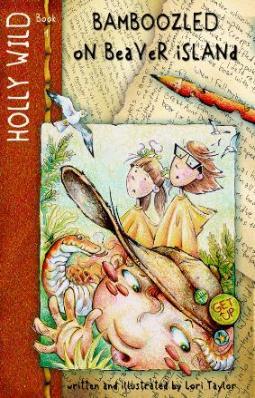
It's Elementary: Bamboozled on Beaver Island

Wow, I haven't written a book review since Banned Books Week, back in September.  Color me sheepish - especially since I'd promised a few authors reviews of their books.

It's spring break around here this week, so I'm only working one of my jobs this week.  (Still 40 hours over five days, but I get to sleep in most days and leave early a couple times.)  And I am actually making good on promises.

Today, let me tell you about the first book in the Holly Wild series by Michigan author Lori Taylor.


Statistics
Checkouts: Just talked a student into it last week!
Typical reader: Michigan middle elementary children
Source: The author, at the Outback Art Fair last summer

Synopsis: Holly Wild wants to do something heroic.  Will she have the opportunity to do so with her friends on a trip to Beaver Island?

My Goodreads rating: 5 stars

This is an illustrated novel in the vein of the ever-popular Diary of a Wimpy Kid or Dork Diaries, but significantly less "woe am I" than your average contemporary kids' fiction diary.  Sure, Holly is not necessarily popular, but she doesn't wallow in it.  This is a strong female character, with a healthy interest in adventure and science!  Holly likes squishy, icky, gross things, and can use the scientific method to figure things out.  Rejoice.

I am not big on mysteries, and I will say that I winced when I realized that there was a mystery to solve.  However, this won me over with how fun and adventurous the escapades of Holly, her grandmother, and her friends Sierra and Tierra (twins, obviously) are.  It also encourages the reader to get out and explore the natural world.

This is the first book in a series of at least three novels, all set in Michigan.  It's perfect for children in second through fourth grades.

Tuesday, September 23, 2014

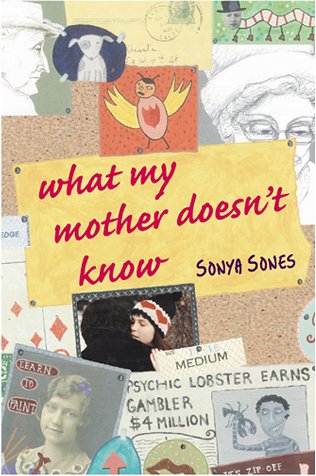
Banned Books Week: What My Mother Doesn't Know

It's that week I get most excited for, Banned Books Week!  I know, I'm such a library geek.  But I put the most planning into decorating for it, more than for any other "holiday."  I research it, and why books are banned, and what's trending in promoting the freedom to read.  And I do enjoy reading banned books.

As part of Banned Books Week, I always like to review a book that's stirred up particular controversy.  Here are my thoughts on What My Mother Doesn't Know by Sonya Sones.  It impressively made the Top Ten Banned/Challenges Books List for four nonconsecutive years.


Statistics
Checkouts: 10 checkouts from my public library (the one I run)
Typical reader: teen and tween girls
Source: My public library

Synopsis: Sophie is a boy-crazy high school freshman.  This is a free-verse account of a few of her romantic flings.

My Goodreads rating: 4 stars

Banned/challenged for (in alphabetical order): nudity, offensive language, sexism, sexual content, sexually explicit, unsuited to age group

This book has quite the curriculum vitae when it comes to controversy.  In 2004, it debuted on the Top Ten Banned/Challenged Books List at #6 for offensive language, being sexually explicit, and being unsuited to age group.  In 2005, it was at #7, for sexual content, and being unsuited to age group.  After a few years off, it came back in 2010 to regain #7, for sexism, sexually explicit, and unsuited to age group.  In 2011, it was #8, for nudity, offensive language, and being sexually explicit.  Wow.

Between the repeat infamy and the title ("Ooo, it sounds scandalous!"), I was expecting something pretty salacious.

... It isn't.

Really, it's one of the sweetest books about teenage romance that I've read.  Granted, I don't read many.  (And when I do, they tend to be angst-filled coming-out GLBT novels with plenty of heartbreak.)  Sophie is boy-crazy and knows it.  But she's a romantic, a serial-monogamist, with some sense in her hormone-addled head, giving her the ability to move on when a relationship is ending and defy peer pressure in certain instances.  No spoilers, but the hints leading to, and the actual, third romance are pretty "aw"-inspiring.

What could be wrong with this book?  (Beware of sass.)

Nudity.  There's a scene where Sophie and her girlfriends go out for a bite to eat in trenchcoats and smiles.  No one sees that they're not wearing anything underneath.  It's their little secret.  A goofy bit of fun.  (And really, unless it's illustrated, how the heck does one criticize a book for having nudity?)

Offensive language.  Sophie is Jewish, and in one instance, a rude man refers to her and her mother using a derogatory word beginning with a K.  Certainly, that's something to get a reader upset over, because they'll otherwise never hear derogatory racial/ethnic slurs.

Sexism.  I don't know.  Maybe when Sophie gets groped by a random boy after a dance, and he comments to his friends that her breasts are real?  Speaking of that scene, Sophie handled it excellently, defending herself and chasing the boys away.

Sexual content.  Sophie discusses getting her period, and tries to buy feminine products.  It's as bad as Are You There, God?  It's Me, Margaret by Judy Blume.  Oh.  Right.  That's been banned and challenged over the years, too.  We certainly can't have girls reading about other girls dealing with menstruation.  They might have been as in-the-dark as Sophie was, without instruction from her mother, and they might learn something from a book like this or the one by Judy Blume.

Sexually explicit.  Certainly, there must have been some eye-widening scenes in this book, for it to be challenged so often for this offense.  But what I found was mostly kissing.  Oh, no, the horror.  How dare teens kiss.  They're supposed to wait until after their Sweet Sixteen.

In sum, this book with the eyebrow-raising title has gotten a lot of undue criticism, in my opinion.  It's a mostly harmless book about a boy-crazy high school girl.  This novel is just a lightning rod that attracts storms from people who are overly protective of girls, and don't want them knowing about anything that can and does impact their lives during puberty.  Get over it.
Thursday, August 14, 2014

Yay for YA: Hold Me Closer, Necromancer

Do you read books that people swear you'll like?  Do you like the suggested books?  Or do you feel like the person had no clue what you actually like?

Dana at Snowbound Books has been recommending the following book to me for several years now, practically since it was published.  And Dana is a pretty good judge of what people could like to read; it's her job as a store owner, and she and I used to work together, so she does know my tastes.  I finally purchased it for the public library, and read it before cataloging it.  Did it live up to her hype?

Statistics
Checkouts: New to the public library
Typical reader: Fans of teen urban fantasy, teens looking for something edgy, fans of ALA award winners and finalists
Source: Snowbound Books

Synopsis: Sam LaCroix, a college dropout working at a burger joint, is surprised to learn that he is a necromancer.  And that he has enemies because of this.

My Goodreads rating: 3 stars (3.5, rounded down)

Let's talk about what young adult literature is.  I took a class on it, back in my master's program.  And from that, I can tell you: everyone has a different definition of it.  It depends on the definition of "young adult."  Are young adults just teens?  Should college students be included?  Can it extend all the way through the 20s, especially considering how many 20-somethings are still in school, still living at home, still unemployed or minimally employed?  Can we judge it based on what the American Library Association awards in the young adult categories?

If we work with a strict definition of "young adult literature is for teens, under 18," I wouldn't call it YA lit.  The protagonist is a college dropout.  There are also elements to the book that would make me hesitate to hand it to immature high school students.  If they pick it up on their own, fine, it's their business and their parents' or guardians'.  I'm not one to censor.  But would I put this in a school library?  No.  Would I shelve it in a teen section?  *squirm*  Eh ...

On the other hand, ALA committees liked it and called it YA.  Hold Me Closer, Necromancer was a finalist for the 2011 William C. Morris Debut Award, which is for a new author's first book in the YA realm.  It was also on the YALSA (Young Adult Library Services Association) Best Fiction for Young Adults top ten list for 2011.

I also don't think it would appeal to typical adult readers.  If your library has a "new adult" section, perhaps this book should be there.  It's probably the best place possible.  If not, YA works.

What did I actually think of the book?  I suppose you are here for the review.

I greatly enjoyed the character development.  Learning about Sam's background, which had many secrets and tantalizing revelations, captivated my interests.  Characters are well-rounded, intriguing, and quirky.  And the back of the book is amusingly vague, almost misleading, about his "undead friend" and "hot werewolf girl."  Surprises can be fun, particularly in this book.  I thoroughly enjoyed finding out all of what James was.

The plot ... it was an interesting twist on coming-of-age and finding one's place in life, certainly.  But if you read a lot of this sort of genre, it blends in and is unremarkable.  It suffers from a problem that gamers familiar with the Old World of Darkness settings would understand: The trope that everyone is actually supernatural, and the last human just became a hunter.  Yawn.  A bit of normalcy would have been exciting, if you get where I'm coming from.

That said, I did enjoy it overall.  I could find myself reading the sequel, because there is a curious thread left hanging.

Monday, August 4, 2014

Yay for YA: The Fault in Our Stars, by John Green

I haven't written in a couple weeks, despite having books to review.  I apologize.  It's because my review is of John Green's The Fault in Our Stars, which has been hugely popular and made into a movie.  That's very stressful, reviewing something familiar to the masses and something that could draw viewers to this blog.

But without further ado:

Statistics
Checkouts: New to both libraries
Typical reader: People curious about the hype/movie; fans of John Green
Source: Snowbound Books for the public library's copy; Scholastic for the school's

Synopsis: Hazel is a teen with terminal cancer.  At her support group, she meets Augustus Waters, who shakes up her existence.

My Goodreads rating: 4 stars

There are two reasons a teen book becomes immensely popular: either it's so horrible that it's incredibly accessible, or it's amazingly good, yet can have widespread appeal.  John Green, thankfully, is a good writer, and can hit nerves with many readers.  Overall, The Fault in Our Stars is a worthwhile book.

I enjoyed the fact that this book used its fictional bits and put them out into the real world.  You can find Hazel's favorite book, An Imperial Affliction, on Goodreads, which thrilled me.  Or ... at least it was on there while I was reading the book.  Alas, the link is now broken.

I also liked that the ending was not what I predicted.  It could matched a foreshadowing in An Imperial Affliction.  That would have been a little cliche, which this book is not beyond doing.  I knew a particular character's fate as soon as he was introduced.  Good heavens.  But some things did go past what I expected, and I was grateful for that.

The author, Peter Van Houten, is a great conversational piece, because he's such a jerk.  At least once while reading this, I put the book down, went to my partner (a budding author), and said, "Honey, don't ever be like this guy."  While Hazel and friends were engaging, Van Houten evoked the most emotions.

Fans of John Green's other books and interesting characters will delight in how quirky Augustus is.

This is a good, though not mind-blowing, book.

Wednesday, July 2, 2014

Yay for YA: My Basmati Bat Mitzvah, by Paula J. Freedman

I think that getting back into reviewing books with one of the best contemporary preteen books I've read in a while is a good way to do this.


Statistics
Checkouts: Not owned by either library ... yet
Typical reader: Preteens or teens interested in contemporary coming-of-age books, have ties to either ethnicity/religion portrayed in this book, or are attracted by the quirky, catchy title
Source: Advanced reading copy courtesy of Snowbound Books (It came out last October.  I'm behind in my reading.)

Synopsis: Tara Feinstein, an Indian-Jewish-American preteen girl living in New York City, is preparing for her bat mitzvah.  Being multicultural, she's not sure in how she fits in to either her mom's Indian culture or her dad's Jewish one, or what exactly she even believes.  Adding to her worries are the fact that her best friend Rebecca is spending more time with a snobbish girl from both their middle school and Hebrew school, and her other best friend Ben-O may or may not like her as more than a friend.  Oy vey!

My Goodreads rating: 5 stars

I really enjoyed reading this book.  Ever have a book that you're reading, that's so good that you slow down and try to drag out the last few chapters so it will last longer?  This book was like that for me.

It's well-written.  The dialogue and internal monologue are realistic and believable.  There was a decent balance of description - not so little that it would turn me off, and not too much for a preteen reader.  Characters are well-rounded.  The plot and subplots are interesting, yet resolvable by the end of the book.

And best of all, it has a glossary.

Don't worry, I am kidding when I say that a glossary is the best thing about a book.  But it helps!  Hardly anyone is going to be familiar with all the Yiddish, Hebrew, and Hindi words, much less the blended ones.  The glossary is also seasoned with the humor of the protagonist, making it part of the enjoyable read.

I'd be hard-pressed to nitpick and find little flaws with this book.  Sure, it's not perfect - nothing is - but this is really darned good.

Saturday, October 12, 2013

Cover-to-Cover Commuting: Burned, and Smoke, by Ellen Hopkins

I had intended to review these two books during Banned Books Week, or shortly thereafter.  It's now two weeks later.  Good heavens, I hope my readers don't actually expect me to be timely, or if you do, you forgive me.  I'm a library director, and I have a second library job.  Both jobs are a lot of work, and consume a lot of time and energy.  Much as I'd love to blog more regularly, that's not going to happen.

Librarians are like teachers.  Overworked and underpaid.

 Enough of that, though.  Let me tell you about these audiobooks!  Burned was published in 2006, while its sequel, Smoke, came out last month.

Statistics
Checkouts: Both owned in print and audio format at the small public library
Typical reader: Teens, fans of the author
Source: Burned was interlibrary loaned; Smoke was cataloged and checked out to me the day it arrived, hehe

Synopses: In Burned, Pattyn von Stratten is the eldest daughter in a fundamentalist home with an abusive father and useless mother.  Enraged by her really fairly typical teen actions, her father sends her away to his sister's ranch in rural Nevada.  There, she finds happiness and hope - which she must leave when the school year begins.  Smoke picks up not long after the cliffhanger ending of Burned, with Pattyn on the run and her sister Jackie picking up the pieces of their lives.  Can they rebuild, despite the lies and pain?

My Goodreads ratings: 5 stars for Burned, 4 stars for Smoke

Pattyn (named for General Patton; her father named all his children for generals) is likely the sweetest protagonist you could possibly find in one of Ms. Hopkins' novels.  The poor girl has a rough life, though, with a father who rules with an iron fist - which he often uses against his wife - and a fundamentalist church that looks the other way when its women need help.

When Pattyn gets into trouble with her father and at school due to a boy, she is shipped off to live with an aunt who has a ranch in rural Nevada.  This is meant as punishment, but it turns out to be the exact opposite.  There, she learns how it feels to be loved, both by her kind aunt and by a nice neighbor boy.  Love is a double-edged sword, however, which she learns when she returns home to face reality.  And man, can the consequences of love be disastrous.

The second book is narrated by both Pattyn and her sister, Jackie.  Pattyn is on the run after a horrific series of events, and tries to rebuild her life posing as an illegal immigrant worker to become a nanny on a rural Californian ranch.  (And that didn't come across as ridiculously in the book as it does when I type it.)  Meanwhile, Jackie has her own demons to face, and must help her mother and sisters cope with all that's happened.  It's a lot for a young teen girl.

Smoke is different from any other novel by Ms. Hopkins that I've read.  It's filled with so much hope.  Fans may find themselves torn between grabbing onto that hope and expecting everything to turn out okay for Pattyn and Jackie, and being cynical and waiting for it to all come crashing down, especially for Pattyn in her new life.  Can there be a happy ending?

Saturday, September 28, 2013

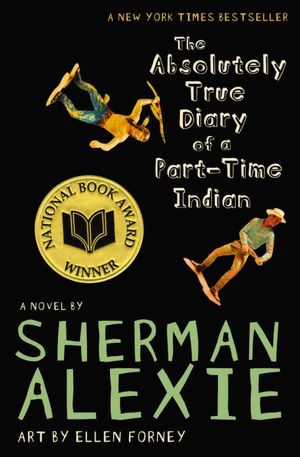
Banned Books Week: The Absolutely True Diary of a Part-Time Indian

I must say, I am shocked at how well Banned Books Week went over at my library.  Pleasantly shocked, certainly.  But still, I am in awe of just how positively the community responded to it.  People were curious, and asked questions.  And they checked out the books.  Of the Top Ten Banned Books of 2012, only The Kite Runner and Beloved were left on the shelf when I closed up this afternoon.  There seems to have been a reluctance to take the books with the pink slips on them, but hopefully those will go out next year.  Hopefully by then, the library will be in its new home (just down the street) and I'll have more room to make displays.

I also celebrated Banned Books Week by listening to book number two on the 2012 list, The Absolutely True Diary of a Part-Time Indian by Sherman Alexie.  The author himself read the book.

Statistics
Checkouts: audiobook not owned by either library
Typical reader: teens, Native Americans, fans of the author, fans of banned books
Source: my hometown library

Synopsis: Arnold "Junior" Spirit is a 14-year-old Spokane boy who lives on a reservation.  At the encouragement of a teacher, he transfers to a better school 22 miles away, where the only non-Caucasian is its Indian mascot.

My Goodreads rating: 4 stars

Banned/challenged for: offensive language, racism, sexually explicit, unsuited for age group

This is a slice-of-life story of a teen boy who changes his own life by upsetting all norms of his tribe and going to a school off the "rez."  It follows roughly a year of Junior's life, as he navigates his freshman year, friendships, racism and ostracism, loss, and basketball.

In listening to the audiobook version of this novel, I missed out on the art.  However, I gained the hilarious narration of Mr. Alexie.  I stuck the first CD in my car's player before I left the library parking lot, and proceeded to laugh all the way home.  The humor is deadpan and dry, a lot of the time.  But also, the voice the author uses for Junior's voice and internal monologue has an amazingly familiar accent.  Apparently, a brain-damaged teen Spokane boy from a reservation in Washington State sounds like a Finlander Yooper.  Seriously.  He sounds like my dad's Uncle Reino.  If you don't know what a thick Yooper accent sounds like, watch the movie Fargo and listen, particularly to the women in the bar ... or listen to this audiobook.

I loved this book.  It covers a wide range of emotions and life experiences.  Pretty much any teen could read it and recognize something for his or her life.  It's humorous, and it also has plenty of hyperbole.  Many of the stories remind me of American tall tales.

Does this book deserve its negative acclaim?  Let's break it down.
  1. Offensive language.  Everyone has a different definition of this.  But yes, there is a sentence where a character not only drops the F-bomb, but also uses the N-word.  It's a pretty knockout use, too, that really covers ...
  2. Racism.  Yup.  The sentence with the aforementioned words was definitely racist.  And there's also racism between Native Americans and Caucasians.  There's also a sort of racism within an ethnic people, as demonstrated by how other reservation inhabitants called Junior an "apple:" red on the outside, white on the inside.  But it's intrinsic to the story.  If everybody got along, if the US government had not discriminated against Native Americans and pushed many onto reservations, if ethnic groups did not stick together and create out-groups and outcasts, then maybe we wouldn't need stories that deal with racism.  People that complain about racism in this book need a reality check.
  3. Sexually explicit.  This isn't 50 Shades.  The most Junior does with a girl is kiss.  There are "gay" jokes.  The most sexually explicit thing would have to be his admissions that he masturbates.
  4. Unsuited for age group.  Because teens don't read about teens?  Sure, it's not what you might want to hand to a child in elementary school, but that's not its intended audience.  Teens are.  And teens can and should read it, and they can and should handle the book just fine.
In sum, beyond one over-the-top sentence that was important to a plot element (white guy insults Junior, Junior punches him, they become friends), this book is tame and appropriate for its intended audience.

What did you read for Banned Books Week?

Thursday, September 5, 2013

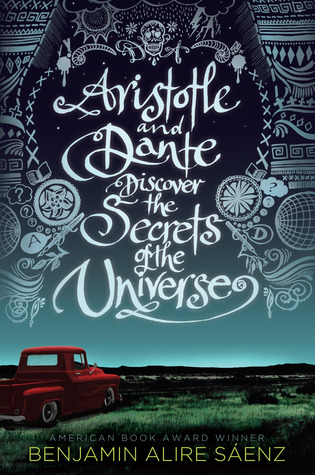
Yay for YA: Aristotle and Dante Discover the Secrets of the Universe

I've gushed over books that have received the Michael L. Printz Award, or have been honor winners of the award, before, so I'll spare you the swooning with this review.  On the other hand, this book (a Printz honor recipient) won a Stonewall Book Award, as well as the Pura Belpre Award, and probably others but the copy I had access to only had so much cover space for award stickers.  And it has a great title.

Today I shall tell you about Aristotle and Dante Discover the Secrets of the Universe.  Doesn't it just sound grand?

Statistics
Checkouts: 1 at the small public library
Typical reader: Teens drawn to literature that isn't heteronormative (I'm not trying for the acronym that keeps growing ...), fans of the author and/or award-winning books
Source: My small public library

Synopsis: In this slice-of-life tale set in the late 1980s, two Mexican-American teen boys become friends and try to find their places in life.

My Goodreads rating: 4 stars

For having such a grandiose name harkening back to a well-known Ancient Greek philosopher, Aristotle (Ari) does not have many far-reaching ambitions.  He feels like his life is someone else's idea.  And in the summer of 1987, he was not aspiring to much beyond lazing about for the summer, perhaps at the pool despite not knowing how to swim.  But at the pool, he meets Dante, another Mexican-American teen boy with a lofty name, who offers to teach him how to swim and thus ignites a friendship.

This is a pretty pedestrian story, very slice-of-life, without goals.  Nothing exciting or thrilling happens for the first hundred pages.  (Then something potentially life-changing does.  But you know me, I don't do spoilers.)  Yet it has so much heart.  Plot is secondary to character and relationship growth and development.  Self-discovery and the complexities of friendships are the key elements of this book, and they really shine.

One part I had problem with was the resolution of the story.  I didn't particularly believe it.  Since I don't give away spoilers, it's hard to explain, but it didn't ring true for me.  While I've been known to be a poor judge of a certain characteristic pivotal to the end of the book, I also don't believe I was led as a reader to reach the conclusion that Ari did.  Your mileage may vary.

Sunday, January 27, 2013

Graphic is Great: Drama by Raina Telgemeier

It has been too long since I've reviewed a graphic novel!  Let me share with you my thoughts on Drama by Raina Telgemeier.

Statistics
Checkouts: Coming soon to both libraries
Typical reader: Tween and teen girls and anyone else interested in theater or Ms. Telgemeier's works
Source: I couldn't pass up a signed copy that was available at Snowbound Books!

Synopsis: Callie loves theater, and she's thrilled when her middle school's drama production is announced to be the musical Moon Over Mississippi.  Singing isn't her thing, but she'll still be happily busy backstage, making the set worthy of Broadway.  But relationship drama of all sorts can be a bit distracting ...

My Goodreads rating: 4 stars

I read Smile by this author a couple years ago, when it showed up in a Scholastic book fair.  That book is a nonfiction graphic novel, an autobiography of Raina and her teeth.  It's both amusing and horrifying.  I'd really recommend it for anyone who has suffered orthodontics or cosmetic dental work - but is not too squeamish.

Ms. Telgemeier has a great, unique art style.  It's very expressive.  Would you get what I mean if I say that it's cartoony yet realistic?  Because that's what I feel it is.  There's also great attention to detail, with foreshadowing that's handled well.  For instance, Callie finds a dress in the theater's storage area that doesn't suit the play.  But there will be some use for it later!

This graphic novel is a lot of fun.  The characters are all so vivacious in their quirky, adolescent ways.  They strike me as being older than middle school students - and I honestly don't know of any middle schools that can put on such large theatrical productions - but then again, I do find my 7th graders to be mature until hormones hit their brains and make them weird, haha.  Anyway, the characters are quirky, trying to find their places in life, exploring the labyrinths of relationships, and pursuing their interests.

Callie is quite the adaptable protagonist.  She's perhaps a little boy-crazy, but she can also roll with the punches.  Through the play, she meets and befriends two brothers, Justin and Jesse.  She crushes on Justin, but quickly finds out through talking with him that he's gay.  (He's a bit stereotypically so, being flamboyant and into theater.)  Callie has no problem with this, treating him just as nicely as ever and setting her sights on Jesse, the shyer, quieter brother who will be on stage crew with her.


This review was delayed last week due to inclement weather - or maybe just poor maintenance practices on the part of the local internet service provider.  Anyway, I feel like this was meant to wait.  Last night I saw the local youth theater's production of The Little Mermaid, Jr. (all actors 18 and under) and it was fantastic.  It's fun to tie life's experiences in with a book you're currently reading, or have read.  Both the cast of the real-life play and the one in this book are so talented.  Plus, perhaps some of my students who were involved will want to continue thinking about theater, and read this book.

Thursday, January 10, 2013

It's Elementary: In Our Mothers' House

It's been a while since I've written a review of a children's picture book!  What I have chosen to talk about today is interesting on many levels.  It's by a Michigan author.  And it's been challenged and banned in several school libraries in various places across the country.  That always makes for an attention-getting topic.

Let me tell you about In Our Mothers' House by Patricia Polacco, and why it's caused a fuss.


Statistics
Checkouts: Not owned by charter school library; own, but not yet checked out at the public/school library
Typical reader: People interested in banned books; fans of Ms. Polacco's works; families that are different
Source: I read it while I was cataloging it at the public/school library.  I admit that I've polished off a few picture books that way, while waiting for files to load or whatnot.  Guilty as charged!

Synopsis: Two women adopt three children and raise them in what seems to the children to be a perfectly normal, happy household.  Some neighbors don't accept them for some reason, but in this house, different does not mean wrong.

My Goodreads rating: 4 stars

This is a pleasant story about a family that adopts three ethnically diverse children and raises them in a warm, fun, loving home.  It follows the family from when the first daughter (the narrator) is adopted, through to the mothers' passing and how the son's family now lives in the house.  It's a very feel-good tale.

The real world, before and after the book, has not been so kind.  Ms. Polacco wrote this book after visiting a class and being inspired by the children she met.  That might sound sweet, but this story was pretty reactionary.  The children in the class she was visiting was reading essays to her, about their families.  One girl got up to read her essay, but was immediately asked by an aide to sit down.

"No dear...you don't come from a real family...sit down!" said the aide.

The girl came from a family of two mothers and two adopted siblings.

Ms. Polacco went back to her hotel room and wrote In Our Mothers' House that night.  (The account is taken from a guest post by Ms. Polacco on the American Civil Liberties Union's "Blog of Rights."  Read the full article here.)

There are apparently plenty of people who feel the same way the aide does.  The book has been pulled from library shelves in Texas and Utah.  The Davis School District in Utah kept the book behind the circulation counter and required parental permission for checkout; there has been a news-making lawsuit filed against the school district.  Parents there had complained that the book normalizes a lifestyle that they don't agree with.

Everyone is entitled to their own opinion, and parents have every right to say what their underage children can and cannot read.  But they should not infringe upon others' rights to read what they please.  The librarians in the district had bought the book for the collection because there are students that come from homes with two mommies or two daddies.  Yet the community continues to treat the children as if they do not have the right to feel normal or happy.

Does your local library offer books to make everyone feel like they are a welcome part of society?  Or do you have a tale of a locally banned book, that could have possibly helped someone feel better about themselves?


Don't forget to enter my drawing for a $25 Biblio gift card!  You'll find the entry form here.  The giveaway ends January 31.

Sunday, January 6, 2013

Yay for YA: Choke, by Diana Lopez

I seem to have been on a bit of a teen problem novel kick lately.  Here's my review of a fairly new book called Choke by Diana Lopez.


Statistics
Checkouts: New to the charter school library
Typical reader: Middle school and teen girls
Source: Scholastic book fair, recommended for the collection by a high school student

Synopsis: Windy is a fairly typical eighth grade girl, in the "general population" of her school hierarchy, wishing she could change her appearance, improve her grades and her status, that sort of thing.  She seems to hit a lucky break when a new girl, Nina, comes to school and befriends her.  Nina even wants to be "breath sisters," but as Windy finds out what this means, she's not so sure she wants to be a breath sister.

My Goodreads rating: 4 stars

Let me start by saying that while this is written below the reading level of the intended audience, I understand why.  The author is a teacher who encountered the problem dealt with in this book, and to get out the warning to everyone likely to be intrigued by "the choking game," she had to write it more simply than the grade level.  It's like how newspaper articles are written approximately to the third grade reading level, so the largest literate audience can benefit from them.  The struggling, reluctant reader can read an interesting, current novel that doesn't get too preachy, just as the top student in the class can.

So, don't expect the prose to be breathtaking.  (Sorry, the pun just slipped out.)  The plot is a bit predictable, too.  The characters and the realism hold the book together, though.  Windy is as quirky as any protagonist you'd find in a John Green novel, and is realistic and well-rounded.  She has high and low points, interests that any middle school girl would have, and problems any could encounter as well.  Middle school is a tumultuous time of establishing pecking order, and a plot of the story lines deal with that.  And what teen or almost-teen doesn't want to fit in and be attractive?  But self-image issues are not the exclusive territory of the young, and Windy's perception of herself is mirrored by her father's struggle to be less Latino to get a job as a TV weatherman.

I didn't find the book to be preachy in its message, which is an important message indeed.  Asphyxiation is not something anyone should be experimenting with.  It's hard to imagine why anyone would try it, but in middle school, there's plenty of peer pressure, and tweens and teens are risk-takers.  People can end up with brain damage from it, or even die.  Remember actor David Carradine's death a few years back?  This isn't just something youngsters try.


On a happier subject, I've passed the 100 mark with GFC (Google Friends Connect) followers this weekend!  How exciting!  I'll be celebrating later this week with a giveaway.  Stay tuned for details.

Thursday, December 27, 2012

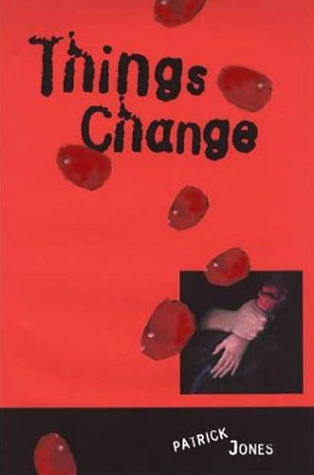
Yay for YA: Things Change

I found a contemporary teen book set in Michigan, written by a Michigan author!  Let me tell you about Things Change by Patrick Jones.


Statistics
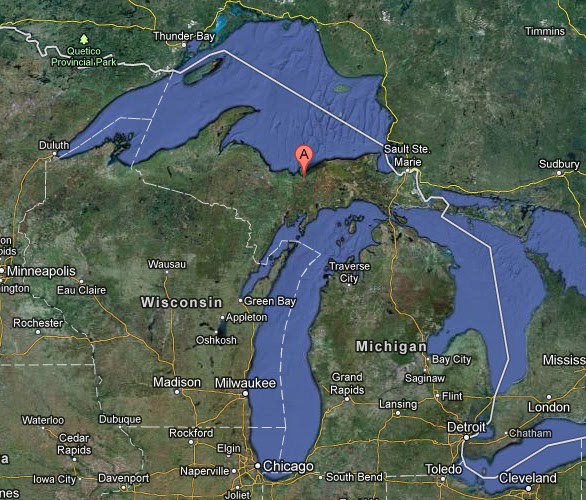
Michigan connection: Patrick Jones grew up in Flint.  Things Change is set in Pontiac, which is between Flint and Detroit.  (See?  I don't just read books set in the U.P. for "Marvelous Michigan.)
"A" is for Pontiac. Image taken from Google Maps.
Checkouts: Not owned by either library
Typical reader: Teens, mainly girls
Source: My hometown public library

Synopsis: Johanna is a high school junior under a lot of pressure to be perfect, from her strict parents and admiring teachers.  Maybe that's why she shakes up her life by telling the wild, class-clown, student council president Paul to kiss her.  They end up going out, and Johanna finds that she's added another high-maintenance facet to her life.  Paul changes a lot about Johanna's life - but can she change him for the better?

My Goodreads rating: 4 stars

Can a leopard change its spots, a skunk its stripe?  A smart girl can fall from her pedestal and get in trouble with a bad boy, but can that bad boy change for the good, to please the girl?

This is a book about a relationship, but it's not a romance.  (If you've been reading my blog a while, you know I don't do romance novels.)  It's what I call a "problem novel," a fictional piece, typically written for teens (or kids, to a lesser extent), about a social issue.  Crank by Ellen Hopkins, which I previously reviewed, is such a book; it deals with the dangers of methamphetamine.  Things Change is about abusive relationships.

Can Johanna succeed in keeping Paul happy so that he doesn't leave bruises when he pokes her?  Will leaving her best friend, Pam, ease his jealousy and keep him from slandering Pam?  Can Paul work to control his temper, or will the abuse escalate?

The novel is mostly told from Johanna's perspective, with a few chapters narrated by Paul thrown in.  They aren't labeled, but Paul's chapters always begin with a typed note to his father, who the reader quickly learns had left Paul and his mother several years ago, and died a couple years back.  It's easy enough to follow.  The prose is at a good reading level - not too simplistic as to be too dumbed-down for the perspective of a top student, but not too complex or adult, either.  There are sexual situations in the story, but anything beyond kissing and petting is "off-camera."

What I appreciated most about this book was that it wasn't cliche.  It surprised me at times, and I liked that.  The characters don't always make the right decisions, but they're very realistic.

Thursday, October 18, 2012

Marvelous Michigan Month: Prairie Evers

I am particularly excited about today's review for Marvelous Michigan Month.  This is one of the books that inspired putting together this feature, along with Haylee's Treasure (among others).  This author is actually one of my patrons!  I have not had the opportunity to meet her yet, as her local library is one of our rural branches/outposts.  I do look forward to doing so sometime, though, be it at a library or at the cafe she and her husband operate.

Let me tell you about Prairie Evers by Ellen Airgood.


Statistics
Michigan connection: Ms. Airgood is a Michigan author.
Checkouts: Coming soon to both libraries
Typical reader: Farm-raised, home-schooled, and previously home-schooled children would likely get the most enjoyment out of this novel.  It's also great for kids who have had to, or will have to, move to a new town and school.
Source: Snowbound Books

Synopsis: This is the story of a tumultuous year in the life of young Prairie Evers, who moved to a farm in upstate New York and will no longer be home-schooled by her beloved grandmother, a former school teacher.  She feels like her chickens: cooped up and subject to the pecking order of the school her parents send her to.  But she will make a friend, and learn much about life.

My Goodreads rating: 5 stars

This is such a nice, sweet book.  If you're looking for a feel-good book that still does have problems for the characters to face, this is a good choice.

The eponymous protagonist of the novel is smart, kind, thoughtful, and spunky.  She's pretty resistant to change, though.  This provides the conflict of the novel, when her grandmother, who has been her teacher and closest friend, decides that life on the farm in New York isn't for her, and moves back to North Carolina.  Her parents are willing to finish out the school year at home before sending Prairie to school, but between needing to make ends meet and some wicked town gossip, Prairie must face the music and go to the dreaded public school instead of staying home all day with her new flock of chickens.

This is a good book for both sides of the argument on homeschooling versus conventional schooling.  There are pros and cons to each, and even young Prairie can see and contemplate that.  She had a good case for homeschooling in North Carolina, being far from the school and having a trained teacher available to educate her.  But in New York, she will learn that going to school has such benefits as being part of society and making friends.

The friendship with Ivy is the real adventure.  Prairie never really had an opportunity to make friends her own age before, so this is totally new to her.  There are ups and downs, and Ivy certainly has problems of her own to deal with, but Prairie is a determined optimist who wants everything to turn out right.

This is a great book for upper elementary students.


UPDATE: A few hours after I posted this review, I cataloged and processes two copies of this book for the school/public library.  When I said it was coming soon, I didn't think I meant today!  :)

Tuesday, October 16, 2012

Marvelous Michigan Month: The Disappearance of Dinosaur Sue

Wow, this month is just flying by!  I hope I'll get through all the books I have planned for Marvelous Michigan Month.  Whether I do or not, I think I'll make this a regular feature once a month.  It's good to be familiar with Michigan books for my jobs, and it's fun to share these books with a broader audience who might not otherwise find these wonderful works.

Today, I would like to tell you about the first in a series of mysteries for children, written by a very knowledgeable person.  This book is The Disappearance of Dinosaur Sue, the premiere book in PaleoJoe's Dinosaur Detective Club series by PaleoJoe (Paleontologist Joe Kchodl) and Wendy Caszatt-Allen.

Statistics
Michigan connection: PaleoJoe is a Michigan author.
Checkouts: Coming soon to the charter school library
Typical reader: Elementary students interested in dinosaurs
Source: The author, when he visited the school/public library!

PaleoJoe holds a replica tooth of a Tyrannosaurus rex.
Photo credit: the school/public library where I work.

Synopsis: Junior paleontologist Shelly Brooks, a lively, enthusiastic eleven-year-old, helps PaleoJoe investigate the disappearance of Dinosaur Sue from the Field Museum of Natural History in Chicago.  Dinosaur Sue is the most complete skeleton of a Tyrannosaurus Rex ever found.

My Goodreads rating: 5 stars

This is a work of fiction, though PaleoJoe is a real paleontologist, and Dinosaur Sue really is the most complete skeleton of a Tyrannosaurus Rex ever found, and is really on display in the Field Museum of Natural History in Chicago.  A lot of the facts about her in the book are true.  But she has never been stolen.

I had initially given this book a 4-star rating, but upon reflection, bumped it up to five stars.  This is a very readable, fun, informational story.  I'm happy that the protagonist is a girl interested in paleontology, even if she is a bit annoying.  And for a mystery, I liked it.  This, and the other four books in the series, will be great additions to the library collection.

PaleoJoe has been traveling across the state and the Midwest to schools and libraries, offering educational programs about paleontology and dinosaurs.  If you have the opportunity to take in one of his programs - or book one, if you work for a school or library - do so!  He is very informative, if fast-paced.  I learned a lot, ranging from how small a Tyrannosaurus rex's brain really was, to how "dinosaurs" are really only the ones that walked on land; pterodactyls were flying lizards, and plesiosaurs were aquatic lizards.  For more information about PaleoJoe, his work, and his programs, please visit his web site.

Wednesday, October 3, 2012

Marvelous Michigan Month: Haylee's Treasure

Welcome to my Marvelous Michigan Month, where I'll discuss books of all sorts dealing with my home state!  There will be books about Michigan, books set in Michigan, and books by Michigan authors.  Some will be for little kids, others will be for older kids or teens, and some will even be for adults.  I might even treat you to a movie - at least, a review of one.

Let's start with a book for upper elementary students.  It's called Haylee's Treasure, written by Mara MacKay.  It recently won a State History Award from the Historical Society of Michigan for its informative and engaging story based on the history of the Upper Peninsula’s Munising area.


Statistics
Michigan connections: Ms. MacKay lives in Michigan, as does illustrator Stephanie Bajema.  Haylee's Treasure takes place mainly in Munising, Michigan.
"A" points to Munising. Screenshot of Google Maps.
Checkouts: Coming next spring to the charter school library, when the second edition comes out!
Typical reader: Upper elementary students looking for a Michigan story
Source: The author!

Synopsis: Haylee and her dad take a summer trip north to visit his parents (her grandparents) in rural Upper Michigan.  Despite her early trepidation, Haylee enjoys finding treasures of all kinds in the small town of Munising.

My Goodreads rating: 4 stars (5 when the second edition comes out!)

As you'll read more about in the upcoming interview with Ms. MacKay, there is a really great idea behind this book, and the sequels to come.  Haylee's Treasure focuses on parts of the history, art, culture, scenery, and artifacts of Munising.  Inspired by an heirloom Munising bowl from her grandmother, Ms. MacKay researched the bowl and found herself wanting to write about the bowl factory and the surrounding area.  Creating the book was also a collaborative effort, with many people contributing to the art, knowledge, and much more.

This novel is a gentle read, very much a slice-of-life exploration of what a remote Michigan town offers.  Haylee learns a lot, and readers of all ages can as well.  It is written for about a 3rd or 4th grade reading level, but would appeal to a wide audience.  The art is beautiful and realistic.  There are even historical photos included.

Let me explain my rating, and why it will change when the second edition comes out (expected Spring 2013).  When I read the first edition, I came across a bit of a stumbling block in trying to read it.  The writing was a bit unpolished and needed proofreading.  For example, verb tenses would change in the middle of a paragraph, or even in a sentence.  But I knew this had a great story and idea at its base, and deserved to be improved.  Having met Ms. MacKay this summer at a summer reading event, I dropped her a line, offering to help edit.  I received a "Yes!" and then my boyfriend and I took on the task of proofreading and editing.  He deserves the credit on editing the book for the second printing.  :)  I'm looking forward to seeing the revised edition in a few months, and sharing it with my students.  See what a collaborative effort this is?

Haylee's Treasure is independently published.  There are places all over Michigan where you can find this book for sale, as well as in a couple of Minnesotan stores.  For a store carrying the book, click here.  Otherwise, the book can be ordered directly from Old Wood Press at the web site.

Sunday, September 30, 2012

Banned Books Week: Crank, by Ellen Hopkins

Unlike last year, I'm taking Banned Books Week seriously here and reviewing a book that has been banned and challenged.  I recently listened to the audiobook version of Crank by Ellen Hopkins, and realized that it was perfect for this feature.  It has been challenged for drugs, offensive language, and being sexually explicit.  This has happened all over the country, often with the worst result possible: it's been banned.  It was #4 on the American Library Association's most frequently challenged book list for 2010.  The author, who has had many of her books challenged or banned, has even been repeatedly dis-invited from speaking events.

That's particularly sad because Crank is semi-biographical, about Ms. Hopkins' own daughter's descent into drug use.

So let's take a look at this book.


Statistics
Checkouts: not owned by the charter school; 6 checkouts of the paperback at the school/public; no statistics available for audiobook (interlibrary loan)
Typical reader: curious teens, and drug users
Source: Interlibrary loan

Synopsis: Kristina Snow was the perfect daughter and student.  Then she went to visit her father one summer, where she tried crank - the monster, methamphetamine.  At first, it was great.  But then it led her into a special sort of hell.

My Goodreads rating: 4 stars

I went with the audiobook for this one because it's written in free verse.  Between my dislike for that form of poetry, and the fact that I just can't read poetry (blaming high school English for that), it seemed like a good choice.  And it is, just for time's sake - the audiobook is 4 discs long, whereas the paperback is a whopping 537 pages.  But it's also good for the quality of narration.  Laura Flanagan delivers the story well, with feeling and a teen-sounding voice.  She handles the verse format better than I ever could, making it more lyrical and less cumbersome.

Crank is a rough book, any which way you read it.  It deals with some very hard subjects.  Kristina gets into a lot of trouble due to her drug use.  This includes trouble at home with her family, with her finances, at school, with her friends, and with boys.  Some of that is very serious.

This book has been banned and challenged for drugs, offensive language, and being sexually explicit.  Well, yes, it does have all of that.  Sometimes people challenge books for the oddest perceived faults; this time, they're right.  The book is about drug use.  Is it glamorized?  Hardly.  There's offensive language, but that seems superfluous.  As for being sexually explicit, let me give you some spoilers.  Kristina gets raped, and that is described a bit.  It's worth cringing over.  She talks with a fellow female drug user about it, and finds out that it's happened to the friend as well.  Girls that use drugs often get raped by dealers, or by guys that offer to help them get high.  And as a final lesson in what bad things can happen when a girl uses drugs, she discovers that she's pregnant, and it's the rapist's baby.

Is this appropriate for young children?  No, but I doubt anyone found it in an elementary collection.  Is it appropriate for teens?  That's a good question.  It's written for teens, about a teen, based on a real teen girl.  But parents should certainly be aware that their teen is reading it.  This is a novel that needs discussion.  Don't take it away, just because of a fear that it might make them curious or lead them astray.  The consequences of Kristina's drug-addled actions become clear enough by the end of the book.  Discuss it with them.  Talk about how drugs can mess up their lives.

I really have to give kudos to Ms. Hopkins for writing this book and its direct sequel, Glass.  She was struggling with how and why her daughter could go down the path of meth use, and this book explores what happened, or may have happened.  She's been praised by people who have used meth, for accurately portraying what it's like.  Some have even told her how the books have helped them clean up.

If that's not a reason to keep the book on the shelf, what is?


Have a good Banned Book Week, everyone.  Enjoy your freedom to read.  Do you have a favorite challenged book, or one that you're reading in honor of this week?


On to a lighter subject.  Tomorrow is the first day of October.  October shall be a special month here, where a librarian moonlights as a librarian.   I'm going to take the month to focus on books of Marvelous Michigan!  I'll be exploring new and old books for all ages, that are by Michigan authors, or are set in Michigan, or are about this state of pleasant peninsulas.  I might even have an author interview or two.  Stay tuned - I hope you'll love it.

Monday, September 10, 2012

Cover-to-Cover Commuting: Looking for Alaska

I am a fan of the Printz Awards.  If you're into young adult literature, or are involved in librarian-like pursuits, you're probably familiar with them.  Akin to the Caldecott and Newbery Awards for younger audiences, the Michael L. Printz Award is the American Library Association's award for a book that "exemplifies literary excellence in young adult literature."  For more information, visit the ALA's page about it.

I've previously read other Printz winners, such as the gritty Ship Breaker by Paolo Bacigalupi (review available here), the quirky graphic novel American Born Chinese by Gene Luen Yang, the heartbreaking The First Part Last by Angela Johnson (that was for a class), and the bleak Monster by Walter Dean Myers.  All of those have been very good.  The book I want to share with you now is also an outstanding Printz winner, called Looking for Alaska by John Green.  I listened to the audiobook version.


Statistics
Checkouts (School/public audiobook): 30
Checkouts (Charter school print):5
Typical reader: Mature teens
Source: School/public library, on audio CD

Synopsis: Miles decides to leave home and attend his junior year of high school at his father's alma mater, a boarding school in Alabama, hoping to find more to life and discover his "Great Perhaps" (a reference to the last words of Francois Rabelais).  There, he makes friends with interesting classmates, most notably the beautiful, clever, sultry Alaska Young.  This comes across as a great "slice of life" tale, until one night ...

My Goodreads rating: 4 stars

Does Looking for Alaska exemplify literary excellence in YA lit?  Oh, yes.  It's genuine, edgy, unafraid to look at teen issues.  While the Printz Awards can go to any genre of book, provided that the intended audience is teen/YA, this is lovably contemporary, realistic fiction.  As much as I like fantasy and dystopian novels, this had great appeal for the realism: in the characters, in the events, in the setting.

This is character-driven, and the people in Miles' life are quirky and interesting.  Miles himself, or "Pudge," as he is known at school since he's skinny,  has the unique trait of being obsessed with last words of famous people.  Alaska is extremely multifaceted, from being sweet and funny, to railing against the "patriarchal paradigm," to withdrawing into deep melancholia.  Even the allegedly one-lunged religious studies professor has his idiosyncrasies.

This is a hard book to discuss without getting into spoilers, though.  There's definitely a turning point in the novel, and the chapters/sections are even marked with "eleven days before" or "one day after."  Certainly, something momentous happens, but if you've been reading my reviews for a while, you know I try to steer clear of letting things slip if I can help it.  My advice: if you want to read this, just jump into it, and don't look at the reviews on Goodreads.  I made that mistake, and was not happy.

The audiobook version of this was good.  Not outstanding, but good.  There's a part where Miles, narrating the story, comments on someone's Southern drawl, and that most people at school didn't have such an accent.  *sigh*  Maybe it's just my acclimation to how people in the upper Midwest talk, but I swear a lot of the characters had a bit of a Southern accent.  Nice to listen to, but inaccurate.

This novel is certainly for more mature readers.  Miles and his friends live boarding school life to its fullest.  They pull pranks, smoke, drink, explore their sexuality, and examine the meaning of life, be it in pursuit of the "Great Perhaps" or a way "out of the Labyrinth."  There are also mature themes.

Tuesday, August 7, 2012

Cover-to-Cover Commuting: Heist Society

As I journey through the land of audiobooks with my new commute, I'm finding the vista sorely lacking in listening options for young people.  Maybe it's just the libraries that I frequent, but I'm hard-pressed to find many audiobooks on CD for teens.  (There are a good number available digitally through the libraries, but listening to my MP3 player in the car seems akin to talking on the phone - not a good idea.)

What I'm finding in the sparse collections, however, are really quite good.  See my previous review of Harlan Coben's Shelter.  Or, continue reading this to find out about Heist Society by Ally Carter.

Statistics
Checkouts: 5
Typical reader: Readers of mysteries
Source: The school/public library

Synopsis: Katarina Bishop, an experienced but young thief, needs to steal priceless art pieces back for a mobster who was robbed of them and blames her father

My Goodreads rating: 4 stars

I really enjoyed the narrator for this book.  Angela Dawe has a wonderful voice, in clarity, range, and pleasantness.  Each character is unmistakably portrayed with a unique tone, matching his or her age and sex well.  And accents!  It really is quite admirable, how such a variety of accents, dialects, and languages are handled in this audio recording.  Who needs a full cast?

The story is somewhat akin to that of Robin Hood.  At her core, Katarina tries to be a good person, and use her skills to return priceless artifacts to their rightful owners.  But she's still a thief.  And she and her crew of fellow teen thieves do some outrageous (albeit mostly believable?) things.


Sorry this review is a bit short. I listened to this a few weeks ago, plus my memory for the spoken word instead of what I read isn't the greatest. Expect my audio reviews to be more on the short side.

Wednesday, July 18, 2012

Yay for YA double feature: If I Stay and Where She Went

Dear reader, I am sorry for my lack of posts this summer.  I have been reading (or listening to) plenty of books, but I haven't had the time to sit down and write reviews about them.  The school/public library where I started working last month is one of the busiest libraries I've ever worked at.  It is staffed by three people, serves a county of over 9,000, and interlibrary loans like crazy.  I really need to get a new camera, and bring it to work with me, so I can photograph the stacks of books waiting to go hither and yon, waiting for our patrons to pick them up or for the delivery system to take them away.

My shift on Monday is devoted to summer reading, and that's been amazing.  We had a visit from the Ann Arbor Hands-On Museum, complete with an inflatable starlab.  (That was cool when I was a kid, and still is cool for me as an adult.)  A couple weeks ago, an author visited, and a few days ago, we had a paleontologist give a presentation.  Next year, I suppose I'll be the one scheduling all these special events.  Oh, my.

Anyway!  This is supposed to be a double feature review of Gayle Forman's books, If I Stay and its sequel, Where She Went.  Let's get to that.

(All stats are for the charter school's library.)

Statistics
Checkouts: 6
Typical reader: Middle school/teen girls
Source: Follett

Synopsis: One wintry day, Mia and her family go for a car ride, which ends up being her parents' and brother's last.   Mia watches the aftermath unfold around her comatose body in an out-of-body experience, and realizes she has to make a decision to stay in this life or die.

My Goodreads rating: 5 stars

Statistics
Checkouts: Coming this fall to the library
Typical reader: People who loved the first book and want to know what happens next
Source: A giveaway by Authors Are Rockstars!

Synopsis: Adam, Mia's former boyfriend, tries to cope with all that life has in store for him three years after she unexpectedly left him.

My Goodreads rating: 4 stars

If I Stay is an incredibly emotional book.  Mia has a great life and wonderful family, and it all gets smashed in a car accident not far into the book.  Her parents are instantly killed.  She sees herself lying on the snow-dusted side of the road, and from there has a heart-wrenching journey as her comatose body goes through surgeries and hospitals, and her remaining family and friends struggle with loss and hope.  The book is filled with beautiful memories of her awesome, loving parents, her sweet little brother, her teen romance with Adam, and much more.

And then she learns (*SPOILER*) that her little brother died.  If you read the dust jacket/back cover, you knew it was coming.  But it's a fair way into the book, and I feel a little bad including that detail, but it was on the cover, and it's one of the main catalysts that cause Mia to think twice about where she wants to be.  Living without Teddy and their parents seems awful - but at the same time, her friends and Adam are doing everything possible to see her and encourage her to stay.

This book is powerful.  I don't think it's just because I finished it a couple weeks ago, that I'm grasping fruitlessly for any criticism I could offer.  It's an excellent book that has rightfully earned acclaim for being a quick read that reluctant readers could get into.  Book clubs have flocked to it for good reason.  It even made me look up medical terminology to better understand some things mentioned in the book.  Fiction that leads me to learn something gets kudos.

Where She Went continues the story from Adam's perspective.  I didn't enjoy it as much, because it was jarring to go from Mia's narrative to his - I hadn't read the cover, but plunged right in after finishing If I Stay.  The first book is a tough act to follow.

This second book seems like it's better suited to young adults than to the original audience.  There are themes that teens can't relate to as well as college students and older 20-somethings could.  What those themes are, I cannot say, because I'm certainly not going to give away how the first book ended, or what led to the events of the second book.  Ha, you'll just have to read it on your own.


Ms. Forman's duology is a very fine set of work.

Monday, July 2, 2012

Cover-to-Cover Commuting: Shelter by Harlan Coben

I'm just full of ideas for new features lately.  This one is courtesy of my new job.  Every day that I work, I drive roughly 45 minutes each way.  The drive is beautiful, and this time of year there are always sandhill cranes in the grasses near the highway, but it's still a long commute.  My boss strongly urged me to try audiobooks.  I protested a bit, as I prefer print and claim to be a bad listener.  Really, I retain what I read far better than what I hear.  But, I gave it a try with a nonfiction true crime by Ann Rule (to be reviewed in a double feature with another of her audiobooks soon).  It does pass the time.  And, I take in more books than I would otherwise - and therefore have more to review.

Welcome to cover-to-cover commuting, my audiobook review feature.  First, let me tell you about Shelter, a YA mystery by bestselling author Harlan Coben, and read by Nick Podehl.

Statistics
Checkouts: I'll keep it in mind for when I get the charter school's audiobook collection started.
Source: Checked out from school/public library (sources' checkouts: 10)
Typical reader/listener: Teen boys, fans of Harlan Coben

Synopsis: Mickey Bolitar is having a rough year.  His father died in a car accident, his distraught mother turned to drugs and is currently in rehab, and Mickey has to live with his estranged uncle Myron (protagonist of Mr. Coben's primary series).  He starts the new school year on the right foot, with a beautiful, kind girlfriend ... but then she disappears with barely a trace.  Can Mickey find her?

My Goodreads rating: A generous 5 stars

I'm not a fan of mysteries, and was skeptical when my boss practically shoved this book on CD into my hands as she gushed about it.  But, I'm glad I gave it a try.  This really works well as an audiobook, and it held my interest throughout the narrative.  A major reason for this is Mr. Podehl's voice acting.  He captures the tone of a teenaged narrating protagonist very well, with distinctive voices for the supporting cast.  The voices for some of the adult females, particularly the gym teacher, came across as flamboyantly gay instead of feminine, but it worked - that's likely just how Mickey would have imitated her!

If all of Mr. Podehl's work is this good, I may seek out other audiobooks he's voiced.  (Here's a list of works he's been a part of, from his web site.)

The other half of the audiobook, the writing that's being read, objectively pleased me.  The plot was engaging and edgy.  There were side-plots and unraveling back-stories.  I found the characters interesting, particularly Mickey's new friend E-ma, the sassy, plump, emo girl who is initially reluctant to be befriended by a tall jock like the protagonist.  And I must not leave out the goofy sidekick Mickey finds himself with - Spoon, who is unrepentantly geeky and spouts random trivia.  These are such vivacious characters.

While I'm being generous and giving a mystery 5 stars, I do have to say that I realized what I don't like about the genre.  Mickey is just a teen boy, trying to solve what could be a kidnapping.  Other mystery novels feature librarians, caterers, cat owners, and other ordinary people not normally involved in crime-solving ... solving crimes.  Once you go beyond who took Aunt Gertrude's antique candy bowl or where the elderly next-door neighbor buried a box of money during the Great Depression, you're entering territory that's, well ...

... the stuff of cartoons.
Really, when all is said and done in Shelter, I'm surprised the bad guys didn't say something like, "If it weren't for you pesky kids!"

But I know that many people like mysteries, and they probably look at my preferred novels that are full of dragons and magic, and shake their heads too.

If you're looking to try a mystery, give this one a shot.  If you're looking for a step between the Hardy Boys and adult mysteries, this probably fits the bill.  And if genres are irrelevant to you, you're awesome, and so is this book.